
UK Greyhound Tracks: Distances, Stats & What Every Punter Needs to Know
Best Greyhound Betting Sites – Bet on Greyhounds in 2026
Loading...
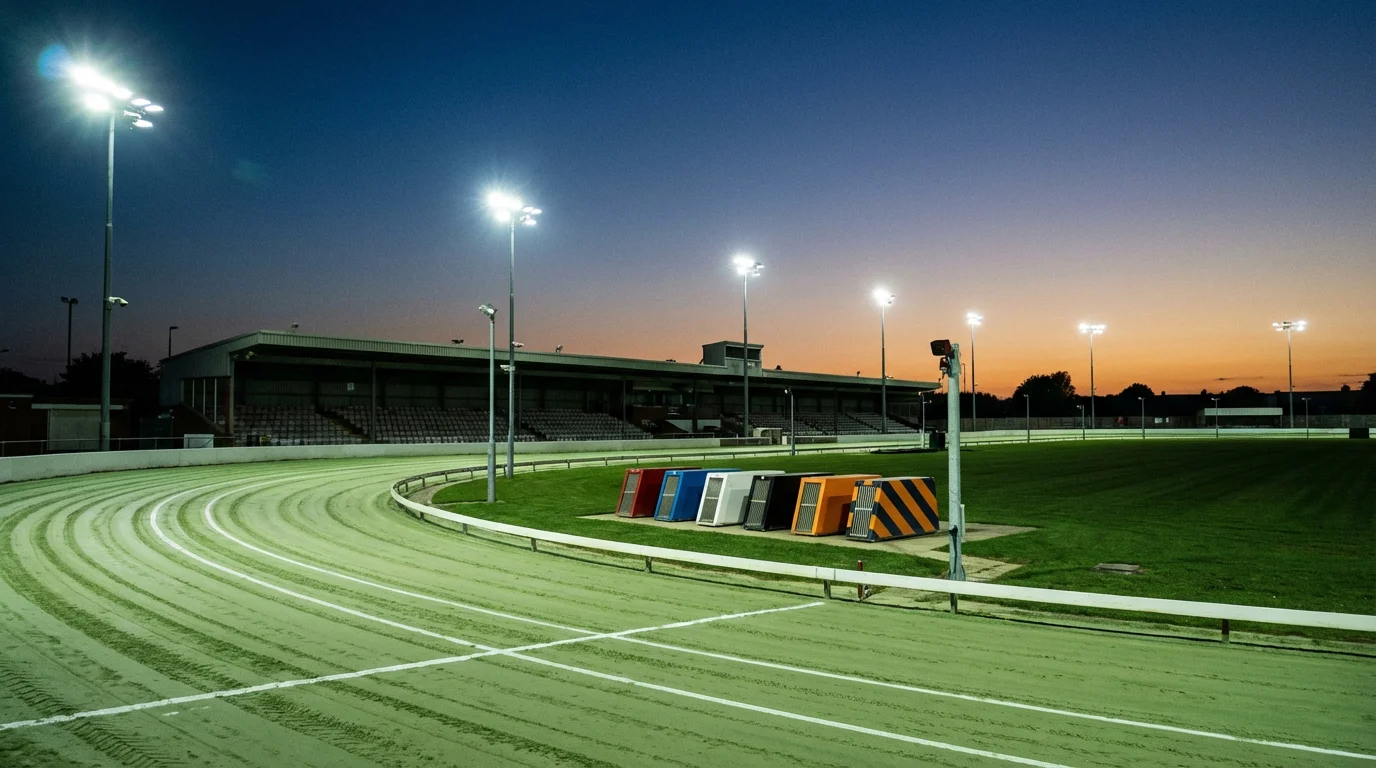
Every Track Has a Personality
UK greyhound tracks are not interchangeable — and the punters who know the differences have the edge. Every licensed track in Britain has its own layout, its own distances, its own pace biases, and its own quirks that shape how races are run and which types of dogs thrive there. A railer that dominates at Romford may struggle at Monmore. A stayer that cruises over 630 metres at Hove might find the Towcester 942-metre marathon a different test entirely. The track is not just a venue. It is a variable, and a significant one.
Most casual punters treat every meeting the same way: study the form, pick the dog, place the bet. What they miss is the layer of context that the track itself provides. A dog’s time over 480 metres means one thing at Sheffield and something quite different at Crayford, because the two circuits run at different speeds, with different bend radii, different surface conditions, and different distances from trap to first bend. Ignoring those differences is like comparing two footballers’ sprint times without noting that one ran on grass and the other on sand.
This guide profiles every major UK greyhound track, examines the distances they offer, breaks down trap statistics that reveal genuine biases, and explains why specialising in one or two tracks is the most effective long-term play for any serious greyhound bettor.
GBGB Licensed Tracks: The Current Landscape
The Greyhound Board of Great Britain regulates licensed greyhound racing across England, Scotland, and Wales. At its peak in the 1940s, the UK had seventy-seven licensed tracks. That number has contracted sharply over the decades, driven by rising land values, declining attendances, and the broader shift of betting from trackside to online. The sport now operates 18 active GBGB-licensed stadia, a figure that remains vulnerable to further closures.
GBGB licensing matters to punters because it guarantees a minimum standard of regulation, welfare, and transparency. Licensed tracks operate under rules that govern grading, race conditions, veterinary checks, and integrity. The form data from licensed meetings is recorded systematically and made available through services like Racing Post, Timeform, and the GBGB’s own results portal. This data is the foundation of serious form analysis, and it is only as reliable as the regulatory framework that produces it.
The closure of Wimbledon in 2017 was the most high-profile loss in recent memory — a track with deep history and strong connections to the sport’s golden era in South London. Other closures have been quieter but no less impactful for the punters and trainers who relied on them. Each closure reduces the circuit, concentrates the dog population at fewer venues, and changes the competitive dynamics of the grading system.
What remains, however, is a circuit with genuine variety. The surviving tracks span the country from Hove on the south coast to Sunderland in the north-east, with a concentration in London, the Midlands, and Yorkshire. Each offers different distances, different race formats, and different competitive characteristics. Some host major events like the English Greyhound Derby. Others specialise in high-frequency evening and afternoon cards that make up the bread and butter of the daily betting programme.
For the bettor, the practical question is not how many tracks exist but how many you can realistically know well. The answer, for most people, is one or two — which is why track selection is itself a strategic decision, and why understanding the differences between venues matters before you commit your time and money to studying one.
London and South East Tracks
Romford, Crayford, and Hove form the heartland of daily UK dog racing. Between them, they host more meetings per week than any other cluster of tracks in the country, and they attract the lion’s share of online betting turnover on greyhound racing. If you follow the dogs even casually, you will encounter cards from these three venues more often than any others.
Romford is a fast, competitive track in East London that races several evenings per week. The standard trip is 400 metres, with 225-metre sprints and 575-metre middle-distance races rounding out a typical card. The track is relatively small in circumference, which means the bends are tight and early speed carries a premium. Dogs that break fast and secure a position on the rail by the first bend have a measurable advantage. The grading at Romford tends to produce competitive fields, and favourites win at roughly the average rate for UK tracks — around 33 to 35 per cent — making it a track where form reading pays off more than simply following the market leader.
Crayford sits in South East London and races on a tighter circuit still. The standard distance is 380 metres, with 540-metre and 714-metre options available on certain cards. The tight bends amplify the inside rail advantage, and Trap 1 historically posts a slightly higher win percentage at Crayford than at most other tracks. For punters, this means that a dog’s running style — specifically whether it is a railer or a wide runner — becomes critical when assessing Crayford cards. A wide runner drawn in Trap 6 can find itself losing ground on every bend, which is a lot of ground to concede on a circuit this compact.
Hove, on the Sussex coast near Brighton, offers a larger track with a more galloping nature. Standard trips include 285-metre sprints, 515-metre middle-distance races, and 695-metre staying events. The wider bends give dogs more room to manoeuvre, and the track tends to favour animals with stamina and a strong finishing kick rather than pure early speed. Hove hosts competitive evening cards and has a reputation for producing reliable form — results that track consistently with the ratings and times. For punters looking for a track where disciplined form analysis is rewarded, Hove is one of the most dependable venues on the circuit.
Central Park in Sittingbourne, also in the South East, is a smaller track that offers afternoon and evening racing. It runs shorter distances and tends to attract locally trained dogs. The grading is slightly less competitive than Romford or Hove, which can create opportunities for punters who follow the local kennels closely and spot class drops before the market fully adjusts.
Midlands and Northern Tracks
Monmore Green in Wolverhampton is arguably the strongest all-round track in the Midlands. It offers distances from 264-metre sprints through to 630-metre staying trips, and its racing programme includes both regular graded meetings and significant open events. The track surface is well maintained and produces consistent times, which makes form comparison between meetings more reliable than at venues where surface quality fluctuates. Monmore’s grading tends to be deep — meaning there are enough dogs in the local pool to fill competitive fields at most levels — and the track attracts several strong local kennels whose runners are worth tracking individually.
Sheffield, racing at the Owlerton Stadium, is one of the fastest tracks in the country. The surface is quick, the bends are sweeping rather than tight, and dogs regularly post times that are noticeably faster than their equivalents at other venues over the same nominal distance. This speed differential is important for punters who compare times across tracks: a dog moving from Sheffield to a slower venue may appear to have slowed down, when in reality the track is simply slower. Sheffield’s standard distance is 480 metres, with 275-metre sprints and 660-metre and 900-metre staying trips available. The track rewards early pace but also gives closers a fair chance on the longer run-in.
Perry Barr in Birmingham has historically been a stronghold for longer-distance racing. The track offers 480-metre standard trips alongside 630-metre and 840-metre staying events, and it has a reputation for developing stayers and marathon specialists. The grading at Perry Barr can be less uniform than at Romford or Monmore, and punters who follow the track closely sometimes find grade drops that the wider market undervalues because the track receives less national betting attention.
Nottingham — at Colwick Park — is one of UK greyhound racing’s most respected venues. Beyond regular racing, Nottingham runs a solid regular programme with standard distances of 500 metres and 305-metre sprints. The track hosted the English Greyhound Derby in 2019 and 2020, and the quality of competition during major events lifts the standard of the entire card. The track is fair in the sense that no single trap position dominates over large samples.
Doncaster, Newcastle in Tyne and Wear, and Kinsley in West Yorkshire round out the northern circuit. Each has its own character: Doncaster is a compact track that favours inside runners, Newcastle offers a good mix of distances on a well-run circuit, and Kinsley is notable for having one of the lowest favourite win rates in UK greyhound racing — a statistic that makes it a difficult track for punters who rely on market signals but a potentially rewarding one for those who do independent form analysis.
Other Notable Venues
Towcester in Northamptonshire occupies a unique position in UK greyhound racing. It is one of the few purpose-built modern greyhound stadia in the country and is the current home of the English Greyhound Derby, the sport’s most prestigious event, having hosted it since 2021. The track’s signature feature is its long distances: the standard trip is 500 metres, but Towcester also offers a 943-metre marathon, one of the longest races in UK greyhound racing. The marathon distance demands a completely different type of dog — stamina over speed, consistency over explosiveness — and the betting markets around it can be less efficient because fewer punters have strong form on marathon specialists.
Sunderland, racing at the Sunderland Greyhound Stadium on Newcastle Road, serves the North East and provides a regular schedule of afternoon and evening meetings. The track is of moderate size with standard distances of 480 metres and shorter sprints. Sunderland attracts a loyal local following, and the trainer pool is smaller than at London or Midlands venues, which means form patterns repeat more predictably once you become familiar with the main kennels.
Yarmouth, on the Norfolk coast, is one of the more remote licensed tracks geographically. It operates a smaller programme than the major venues but fills a role in the eastern circuit. The track is compact and tends to favour early pace. For punters, Yarmouth’s relative obscurity means the betting markets can be thinner and less efficient — fewer people study the form, which occasionally creates value for those who do.
Henlow in Bedfordshire completes the picture as a smaller venue that races regularly without generating the headline attention of Romford or Nottingham. The track runs standard distances with a straightforward grading structure, and its proximity to several strong Midlands kennels means the quality of racing is often better than the modest profile suggests. Tracks like Henlow, Yarmouth, and Sunderland are where patient punters can find edges that the more heavily bet London tracks rarely offer, precisely because less money chasing the markets means less collective wisdom in the prices.
Track-by-Track Trap Statistics
The trap that wins most at Romford is not the trap that wins most at Monmore. This is not a trivial observation — it reflects the physical reality that every track has a different geometry, and geometry shapes which starting positions give dogs the clearest path to the first bend. Trap statistics, when analysed over a sufficient sample size, reveal genuine biases at some tracks and near-perfect equilibrium at others.
At most UK tracks, Trap 1 shows a slight overall advantage in win percentage. The inside rail position gives the dog the shortest route to the first bend and the most straightforward path around it. Across all licensed tracks, Trap 1 wins somewhere in the region of 18 to 20 per cent of races — modestly above the 16.7 per cent you would expect from a perfectly even distribution across six traps. The advantage is real but modest, and it varies significantly from track to track.
Crayford, with its tight bends, amplifies the inside advantage. Trap 1 win rates at Crayford have historically been among the highest in UK greyhound racing, sometimes reaching above 21 per cent over large samples. The outside traps at Crayford, particularly Trap 5 and Trap 6, correspondingly show lower win rates. The geometry explains this: tight bends punish dogs that are forced to cover extra ground, and outside traps put dogs on the longer route at every turn.
At tracks with wider bends — Hove, Sheffield, Nottingham — the trap bias flattens. Trap 1 may still have a marginal edge, but Traps 5 and 6 win closer to their fair share because the wider circuit gives outside runners more room to compete without losing ground. At these tracks, the dog’s running style and early pace matter more than the box number, and punters who over-weight trap statistics at wide-bend tracks are applying a bias that the data does not fully support.
The critical discipline is sample size. Trap statistics need hundreds of races at a specific track before they stabilise into meaningful patterns. A sample of fifty races might show Trap 3 winning 25 per cent of the time, but that number could easily revert to 17 per cent over the next fifty. Genuine bias reveals itself over seasons, not weeks. The sources worth consulting for reliable trap data include the GBGB’s own statistics, Timeform’s track-by-track analysis, and Racing Post’s course profiles, all of which aggregate enough data to separate real signals from random noise.
Using trap statistics sensibly means treating them as one factor among several, not as a standalone selection method. If the form points to a dog and the trap statistics confirm that its draw is favourable at this particular track, you have a stronger case for backing it. If the trap statistics suggest an advantage but the form does not support the dog, the statistics alone should not override your analysis. The trap is where the race starts. The form is what determines how it finishes.
Distances Explained: Sprint, Standard, Stayer
Sprint is under 400 metres. Stayer is above 630. The tactical difference is enormous, and it shapes every aspect of how a race unfolds, from the importance of the trap draw to the types of dogs that compete.
Sprint races — typically 225 to 285 metres — are the shortest events in greyhound racing. They involve fewer bends (sometimes just one), and the race is decided almost entirely by early speed and trapping ability. A dog that breaks cleanly from the traps and hits the bend first will win the majority of sprints, because there is not enough distance for a slower starter to recover. Form analysis in sprints leans heavily on trap times, early sectionals, and the dog’s recent starting record. A dog with a history of slow breaks is a risky sprint bet regardless of its raw speed, because it will never get the chance to use it.
Standard-distance races, typically 400 to 500 metres, are the backbone of UK greyhound racing. Most meetings are built around 480-metre events, which involve a full circuit of the track with four bends. These races test a combination of early pace, tactical positioning, bend running, and staying power. The first bend remains important, but dogs that are strong finishers can overcome moderate starts if they get a clear run through the pack. Standard races offer the fullest test of a greyhound’s all-round ability, and they produce the most reliable form for analysis because the distance is long enough to reveal stamina differences and short enough to still reward speed.
Middle-distance races, from 550 to 630 metres, begin to separate the sprinters from the stayers. Dogs that dominate at 480 metres sometimes cannot sustain their effort over the extra distance, and animals that look moderate at standard trips can come alive with more ground to cover. Middle distance is where the running style analysis matters most: closers gain value because the longer run-in gives them time to reel in front-runners, and early pace merchants face the risk of tying up in the closing stages.
Staying races, from 630 metres up to the 942-metre marathon at Towcester, are a specialist discipline. The dogs that excel here are bred and conditioned for stamina, and the form from staying races should be assessed in its own category. A staying winner who switches to 480 metres may lack the speed to compete, just as a sprint champion moving up to 700 metres may lack the engine to last. Distance preference is one of the most reliable selectors in greyhound form, and punters who ignore it are comparing animals that are essentially competing in different sports.
Why Track Specialisation Is the Smartest Play
You cannot know every track — so pick one and know it cold. This is the single most practical piece of strategic advice in greyhound betting, and it is the one that the fewest punters follow. The temptation to bet on every available card, from the lunchtime meeting at Crayford to the evening fixture at Monmore, is strong. The betting interface makes it easy. The form data is all there. But spreading your attention across a dozen venues means you are perpetually a generalist, and generalists do not develop the depth of knowledge that produces consistent edges.
The advantage of specialisation compounds over time. When you focus on a single track, you start to learn things that are not in the data. You learn which trainers peak their dogs for specific races. You learn which trap positions are genuinely disadvantaged at this particular venue, not from published statistics alone but from watching the races and seeing how the first bend unfolds meeting after meeting. You learn the surface characteristics — which conditions favour which types of runners — and you learn the local competitive dynamics: which dogs in the lower grades are improving, which kennels are going through a strong or weak patch.
This accumulated knowledge creates an information edge. The broader market sets prices based on publicly available form data. The track specialist adds private knowledge — observations, patterns, and context that the average bettor does not have because they are watching twelve tracks instead of one. That gap is where long-term value lives.
Choosing your track is itself a strategic decision. Ideally, pick one that races frequently enough to give you a regular flow of data and betting opportunities. Romford, Crayford, Hove, Monmore, and Sheffield all race multiple times per week, making them practical choices for specialisation. If you live near a track and can attend in person, so much the better — watching live adds a dimension that form data alone cannot replicate. Failing that, most major tracks offer live streaming through licensed bookmakers, which is the next best thing.
The punter who knows one track inside out will, over a season, outperform the punter who dabbles in all of them. This is not a theory. It is a structural advantage built into the way greyhound racing works: local knowledge compounds, and the market does not fully price it in.
Home Advantage for the Punter
Tracks close, new ones struggle to open — but the ones that remain are worth knowing inside out. The contraction of UK greyhound racing is a reality that every participant in the sport has to acknowledge. The days of seventy licensed tracks are gone, and they are not coming back. Land values, planning pressures, and the migration of betting online have reshaped the circuit permanently. What remains is a tighter, more concentrated network of venues that still produces competitive racing and genuine betting opportunities for anyone willing to engage seriously.
The future of individual tracks is never entirely certain. Planning applications, ownership changes, and economic pressures mean that any venue could face a closure threat. But the sport’s core has proven resilient. The tracks that have survived the contraction tend to be the ones with the strongest racing programmes, the most committed ownership, and the most established connections to major events and regular fixtures. They are, in other words, the tracks that justified their existence by producing good racing — which is also what makes them good betting tracks.
For the punter, the lesson from the UK greyhound circuit’s history is that intimate track knowledge is the most durable edge available. Betting systems can be overfitted and lose their edge. Form models can be disrupted by regulatory changes or data availability. But knowing a track — knowing its bends, its surface, its trainers, its competitive rhythms — is an edge that deepens with time rather than decaying. It is personal, it is hard to replicate, and it is exactly the kind of advantage that casual punters will never bother to develop.
Pick your track. Learn its distances, study its trap data, follow its trainers through the seasons. Watch the races, not just the results. Over time, you will develop a feel for the circuit that no data service can fully replicate, and that feel will translate into better selections, better timing, and better returns. The tracks that are still standing have earned their place in UK greyhound racing. The question is whether you will earn yours as a punter who knows them well enough to profit from the knowledge.