Value Bets and Greyhound Racing Odds
Best Greyhound Betting Sites – Bet on Greyhounds in 2026
 Available in US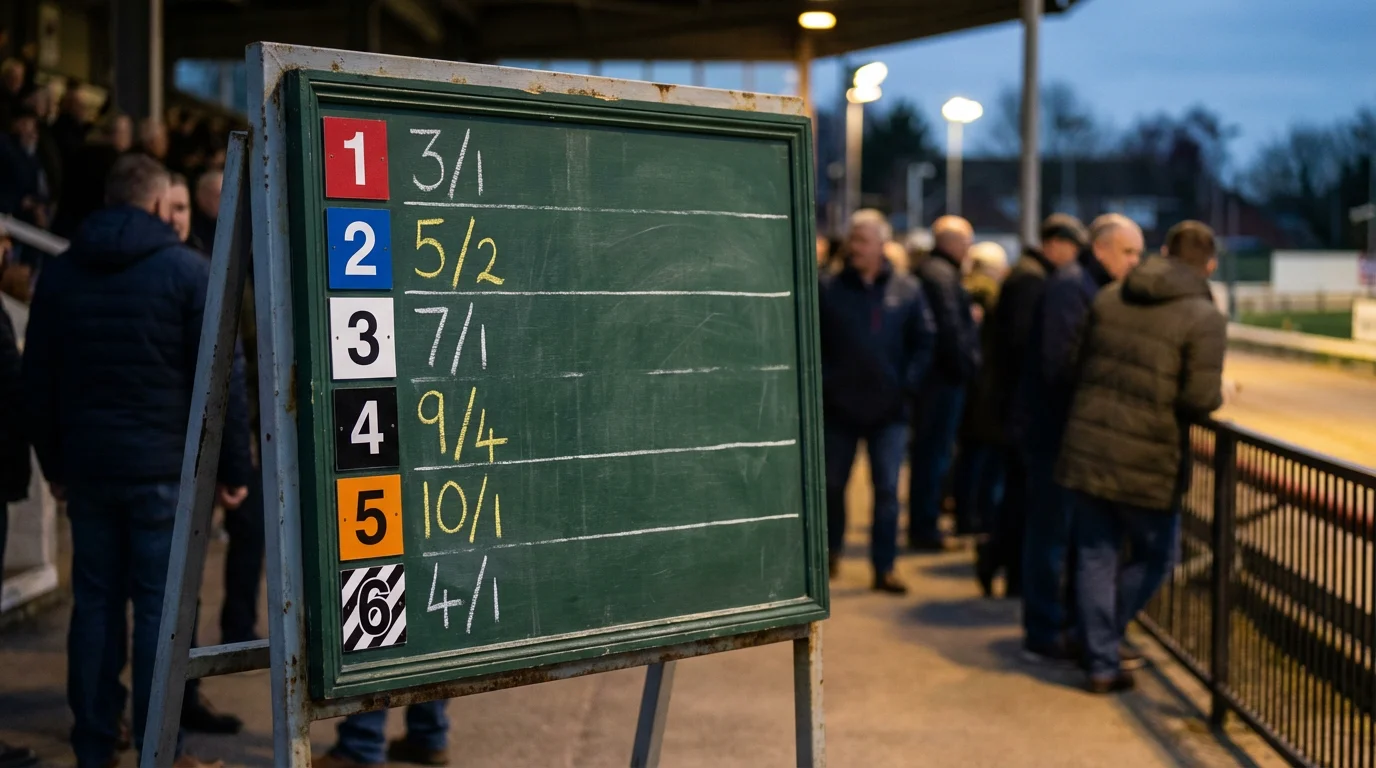
Reading Greyhound Racing Odds to Find Value Bets
Odds are not predictions. They are prices — and prices can be wrong. This distinction is the foundation of profitable greyhound betting, and it is the one that most punters never fully internalise. When a bookmaker prices a dog at 3/1, they are not saying the dog has a 25 per cent chance of winning. They are saying that the balance of money in the market, filtered through their own margin, has settled at a price that reflects a perceived probability. That perception can be accurate, or it can be miles off.
The concept of value sits at the heart of this gap. Value exists when the odds offered on a dog are greater than its true probability of winning. If you assess a dog as having a 30 per cent chance of winning but the market prices it at 5/1 — implying roughly a 17 per cent chance — you have found value. The dog might still lose. In fact, it will lose 70 per cent of the time. But over hundreds of bets at those odds on dogs with that true probability, you will come out ahead. That is the mathematical reality behind every successful long-term betting approach.
Understanding how greyhound odds work, how they are set, and how to identify when they are wrong is not a supplementary skill. It is the skill that separates the punter who wins over time from the one who picks plenty of winners but still loses money. This guide covers every aspect of odds in UK greyhound racing, from format basics through to overround, market movement, and the favourite fallacy.
How Greyhound Odds Formats Work
Fractional, decimal, implied percentage — same information, different packaging. UK greyhound betting traditionally uses fractional odds, and despite the growing adoption of decimals on European exchanges and some online platforms, fractional remains the default for most UK punters and most UK bookmakers.
Fractional odds express the profit relative to the stake. A dog at 4/1 returns four pounds of profit for every pound staked, plus the original stake back — so five pounds total from a one-pound bet. At 7/2, the profit is three pounds fifty per pound staked, returning four pounds fifty in total. At 1/1 (evens), you double your money. The numerator is the profit; the denominator is the stake. Once you internalise that pattern, reading fractional odds becomes automatic.
Odds-on prices — where the denominator is larger than the numerator — indicate a dog that the market considers more likely to win than to lose. A price of 4/6 means you stake six pounds to win four in profit, returning ten in total. Odds-on favourites are common in greyhound racing, particularly in lower grades where one dog is visibly superior to the rest of the field. The returns are thin, and the margin for error is nonexistent: backing odds-on dogs that lose even occasionally will erode a bankroll over time.
Decimal odds, used on exchanges like Betfair and increasingly on continental platforms, express the total return per unit staked. A decimal price of 5.0 is equivalent to 4/1 fractional — a one-pound stake returns five pounds, including the stake. The conversion is straightforward: decimal odds minus one equals the fractional profit ratio. So 3.5 in decimal is 5/2 fractional (3.5 minus 1 = 2.5, which is 5/2).
Implied probability is the most useful way to think about any price, regardless of format. It answers the question: what probability does this price assume? The formula from fractional odds is simple: denominator divided by the sum of numerator and denominator. At 4/1, the implied probability is 1 divided by 5, which is 20 per cent. At 2/1, it is 1 divided by 3, or 33.3 per cent. At evens, it is 50 per cent. Converting odds into probabilities allows you to compare the bookmaker’s assessment directly against your own, and that comparison is where the entire concept of value begins.
Most UK punters do not need to switch formats. Fractional odds are intuitive once you are familiar with them, and the major bookmakers display them by default. But understanding the conversion and — more importantly — being able to think in probabilities rather than prices is the mental shift that moves a bettor from recreational to analytical. The odds are the same information however you express them. The question is always: does this price reflect the dog’s real chance?
Starting Price vs Early Price
Taking an early price is a bet within a bet — you are backing your judgement against the market. The Starting Price, or SP, is the price officially returned on a dog at the time the traps open. It is determined by the on-course bookmakers’ boards at tracks that still have them, or by an industry SP service that calculates the price from the available market data. When you bet at SP, you accept whatever price the market settles on at race time. When you take an early price, you lock in the odds available at the moment you place your bet, regardless of how the market moves before the off.
The decision between early price and SP is a judgement call that depends on your confidence in the dog and your read on market direction. If you believe a dog is overpriced — that the current market has not yet recognised its true chance — taking the early price locks in that value before the market corrects. This happens regularly in greyhound racing. A dog that opens at 5/1 in the morning may drift to 6/1 by the afternoon if money flows elsewhere, or it may shorten to 7/2 if informed punters or kennel connections back it. If you took 5/1 early and the SP comes back at 7/2, you have a materially better price.
The risk runs both ways. If you take 5/1 early and the SP drifts to 8/1, you have locked yourself into a worse price. The dog may have drifted for a reason — a change in conditions, a late market signal, or a factor you missed. This is why SP can be the safer option when you are uncertain. If you do not have a strong view on how the market will move, taking SP means you get the consensus price at race time, which at least reflects the aggregate judgement of the market participants.
Best Odds Guaranteed, which we will cover in detail later, resolves much of this tension. Where BOG is available, you take the early price and are guaranteed to receive the SP if it turns out to be higher. It effectively removes the downside of taking early and preserves the upside, which makes the early price the default intelligent choice at any bookmaker offering BOG on greyhounds. Without BOG, the early-versus-SP decision requires genuine conviction. With it, the decision is made for you.
One practical habit that sharpens your early-price discipline: note your estimated probability before you look at the market. If you rate a dog at 25 per cent (equivalent to 3/1) and the market has it at 5/1, take the early price immediately. If the market has it at 2/1, the value is not there regardless of how the price moves later. Separating your assessment from the market price prevents anchoring — the tendency to let the bookmaker’s number influence your own judgement rather than the other way around.
How Bookmakers Build the Overround
Every greyhound market adds up to more than 100 per cent — that is the bookmaker’s margin. Understanding the overround is not optional for anyone who wants to find value, because the overround is the mechanism by which the bookmaker ensures long-term profit regardless of the race outcome. If you do not account for it, you are systematically overpaying for every bet you place.
The process starts with tissue prices. Before a market opens, the bookmaker’s trader (or increasingly an algorithm) assesses the field and assigns a probability to each runner. In a perfectly fair market, those probabilities would add up to 100 per cent. But the bookmaker needs a margin, so they shorten the odds on each runner slightly — making every dog a little more expensive to back than its true probability warrants. The result is a market where the implied probabilities sum to something greater than 100 per cent. That excess is the overround.
In a typical six-dog greyhound race, the overround might be 115 to 125 per cent. A 120 per cent book means the bookmaker has built a 20 per cent margin into the market. In theory, if they balanced their book perfectly — taking the right amount of money on each runner — they would profit regardless of which dog wins. In practice, books are rarely perfectly balanced, and the bookmaker carries risk on individual races. But across hundreds of races, the overround ensures the house wins.
For the punter, the overround means that simply backing every favourite, or spreading bets across the field, is a mathematically losing strategy. You are paying above the true probability on every selection. To overcome the overround, you need to find dogs whose true chance of winning is greater than the implied probability in the price. In a 120 per cent book, a dog priced at 4/1 has an implied probability of 20 per cent. If you believe the dog’s real chance is 25 per cent, the price offers value despite the overround built into the market.
Comparing overrounds between bookmakers is a practical skill. On the same race, one bookmaker might offer a 118 per cent book while another runs at 125 per cent. The tighter book offers better overall value to the punter, because less margin has been extracted from the true probabilities. Betting consistently with the bookmaker offering the lowest overround on greyhound markets saves money in the same way that shopping for the lowest transaction fees saves money on financial trades. The individual saving on one bet is small, but compounded across hundreds of bets per year, it is significant.
Identifying Value in Greyhound Markets
Value is not about long shots — it is about any dog whose odds are bigger than its real chance. A 2/1 favourite can offer value if you genuinely rate the dog at a 40 per cent chance (implied fair price: 6/4). A 10/1 outsider can offer zero value if its realistic chance is closer to 5 per cent (fair price: 19/1). The concept is entirely about the relationship between your assessed probability and the market price, and it applies at every point on the odds spectrum.
Estimating probability from form is the hard part, and it is where the work happens. There is no single formula that converts a race card into a precise probability for each runner. What experienced punters develop is a calibrated sense of how likely each dog is to win, based on the accumulated evidence: recent form, grade context, trap draw, running style, trainer record, and track suitability. That estimate does not need to be exact. It needs to be more accurate, on average, than the market’s estimate — and in greyhound racing, with its smaller fields and less liquid markets, there are regular opportunities where it is.
Value commonly appears in specific situations. Grade drops are the most fertile ground. A dog dropping from B2 to C1 may have a form line that looks poor — a string of mid-field finishes — but those finishes came against better opposition. The market often underestimates the class advantage, pricing the dog based on its recent results rather than the context in which they were achieved. By the time the dog wins at the lower grade and the market adjusts, the value has gone.
Trap advantage at specific tracks is another area where value hides. If you know that Trap 1 at Crayford wins significantly more than its fair share, and a strong dog is drawn in Trap 1 at a price that does not fully reflect that structural advantage, the gap between the market price and your assessed probability is the value. The same applies to dogs returning from a break with a strong trainer record for first-time-out runners, or improving young dogs whose recent times suggest they are about to outgrow their current grade.
The discipline of value betting requires patience. You will pass on many races where the prices look fair but unremarkable. You will back dogs that lose, because a 30 per cent probability still means losing seven times out of ten. The emotional challenge is trusting the process across a sample large enough for the edge to manifest. Fifty bets is too small. Two hundred gives you a clearer picture. Five hundred is where the maths starts to settle. Value betting is a long-term commitment, and the punters who abandon it after a bad month are the ones who were never truly committed to it in the first place.
Reading Market Movement
When a 5/1 shot becomes a 7/2 shot in the last ten minutes, somebody knows something. Market movement in greyhound racing follows the same basic principle as any other market: price changes reflect changes in supply and demand. When significant money arrives on a particular dog, the bookmaker shortens the odds. When money flows away, the odds drift. Reading these movements can tell you something about how informed participants view the race, though interpreting them correctly requires caution.
A sharp shortening in price — sometimes called a steam move — typically indicates that money from connections or knowledgeable punters has entered the market. In greyhound racing, where information networks are smaller and more localised than in horse racing, these moves can be significant. A dog whose trainer has told associates it is in particularly good form, or one that has trialled impressively without the result being widely published, may attract informed money that moves the price before the broader market catches on.
Drifting prices can signal the opposite: insiders not backing a dog, negative information filtering through, or simply a lack of interest from informed money. But drifts can also be mechanical — a consequence of money arriving on other dogs in the race, pushing those prices down and allowing the remaining runners to drift by default. Not every drift indicates a problem with the dog. Sometimes it just means another runner in the field is attracting disproportionate attention.
The practical approach to market movement is to use it as confirmation rather than as a primary signal. If your form analysis points to a dog and the market is shortening on it, that is a confirmation that others share your view — though it also means the value is being squeezed. If your analysis points to a dog and the market is letting it drift, you may be getting a better price than your analysis suggests it deserves, provided the drift is not based on information you have missed. The most dangerous scenario is chasing steam moves without independent analysis: backing a dog purely because its price is shortening is not a strategy, it is a reaction.
The Favourite Question: When to Back, When to Oppose
Favourites win about 35 per cent of greyhound races — which means they lose about 65 per cent of the time. That single statistic frames the entire discussion about whether backing the market leader is a viable long-term strategy. The answer, as with most things in betting, is that it depends on the price and the context.
The aggregate win rate of around 35 per cent is an average across all tracks and all grades. The number is not uniform. In open races, where the best dogs in a region compete, the favourite’s win rate tends to be higher — sometimes approaching 40 per cent — because the class gap between the top dog and the rest of the field is genuine and the market reflects it reasonably well. In competitive graded races, where the grading system has done its job and produced an evenly matched field, the favourite’s win rate can drop below 30 per cent. The grade and the track matter.
The profitability of backing favourites depends not just on how often they win but on what price they win at. A favourite that wins 35 per cent of the time needs to pay at least 2/1 on average to break even (ignoring overround). In practice, greyhound favourites are often priced at evens to 6/4, which means you need a win rate well above 35 per cent to show a profit. The maths is clear: blind favourite backing across all greyhound meetings produces a long-term loss for most punters.
The smarter approach is selective favourite backing. There are situations where the favourite is the value bet: when a clearly superior dog drops in class and the market has priced it as a modest favourite rather than an odds-on certainty, or when a dog with a perfect trap draw and strong early pace faces a field of closers on a track that favours leaders. In these cases, the favourite may be underpriced relative to its actual chance, and backing it is the value play.
Opposing the favourite is equally valid when the conditions support it. Tight graded races with six evenly matched dogs, races where the favourite has been promoted and faces a step up in class, or cards where the favourite draws an unfavourable trap at a track with a known bias — these are the situations where the favourite’s price does not compensate for the risk. The key is never to treat the favourite as a category. Each favourite is a specific dog in a specific race, and the question is always whether this price on this dog in this race offers value.
Best Odds Guaranteed: Using It Properly
BOG turns early-price betting from a risk into a free option. Best Odds Guaranteed is a promotion offered by most major UK bookmakers, and on greyhound racing it works exactly as the name suggests: if you take an early price and the Starting Price at race time is higher, the bookmaker pays you at the SP instead. If the SP is lower, you keep your early price. You get the better of the two, guaranteed.
The implications for your betting process are significant. With BOG in place, there is almost no reason to take SP on any dog you have formed an early view on. Taking the early price costs you nothing — if the market moves against you and the SP is higher, the bookmaker upgrades your bet automatically. If the market confirms your view and the SP drops, you are already locked in at the better number. BOG removes the downside of early-price betting and preserves the upside, which is as close to a free edge as the betting market offers.
Not all bookmakers offer BOG on greyhounds, and the terms can vary. Some restrict it to specific meetings, others cap the maximum odds at which BOG applies, and some require you to opt in or meet a minimum stake. Checking the terms at your preferred bookmaker is worth the two minutes it takes, because the difference between having BOG and not having it compounds across every bet you place.
The strategic habit is straightforward. Form your view on the race, check the morning or early-afternoon prices, and if you see value, take the early price with a BOG bookmaker. If the price drifts further in your favour by race time, you benefit. If it shortens, you are already protected. Over a season of regular greyhound betting, the BOG upgrades alone can add a measurable percentage to your returns — money that costs you nothing to collect and that the punter who waits for SP leaves on the table every time.
Price Is What You Pay, Value Is What You Get
The punter who bets at 4/1 on a dog with a 3/1 true chance is not unlucky when it wins — they are wrong. That sentence is uncomfortable, because it reframes winning bets as potentially bad bets and losing bets as potentially good ones. But it is the correct framework for anyone who wants to approach greyhound betting as a discipline rather than a pastime.
Results-based thinking is the enemy of long-term profit. A dog that wins at 2/1 but had a 50 per cent true probability offered no value — the fair price was evens. The punter backed a winner and made money on that race, but if they repeat that pattern over hundreds of bets, they will lose. Conversely, a dog that loses at 6/1 but had a 20 per cent true probability was a value bet. The punter lost that race, but the price was right, and the maths will reward them over time. Embracing this distinction requires a shift in how you evaluate your own performance. The measure is not how many winners you picked. It is whether you consistently bet at prices that exceeded the true probability.
Tracking this is harder than it sounds. You need an honest, pre-bet assessment of each dog’s probability, recorded before you know the result. Over time, if your 25 per cent selections are winning roughly 25 per cent of the time and you are consistently getting 4/1 or better on them, your process is working. If your 25 per cent picks are winning 15 per cent of the time, your probability estimates are too generous. If they are winning 30 per cent of the time but you are only getting 5/2, you are leaving value uncollected. The feedback loop is essential, but it only works if you are honest with the inputs.
Greyhound racing is a fast sport with rapid feedback. Races happen every few minutes, results are unambiguous, and the data accumulates quickly. That pace works in your favour if you are systematic about recording and reviewing your bets. It works against you if you are reactive, chasing the last result instead of trusting the process. The odds are numbers. The value is a relationship between those numbers and reality. Your job as a punter is to understand that relationship better than the market does — not on every race, but often enough, across enough races, to turn the mathematics of probability into a genuine edge.
The price is what you pay. The value is what you get. Make sure you know the difference before you place the bet, not after you know the result.
