What Is Starting Price (SP) in Greyhound Racing?
Best Greyhound Betting Sites – Bet on Greyhounds in 2026
Loading...
SP: The Odds at the Off
Starting Price is the official odds a greyhound starts a race at — the final market judgement on its chances, locked in at the moment the traps open. Every dog in every race has a Starting Price, and it serves as the definitive odds reference for that race. If you take SP on your bet, you are paid at whatever the starting price turns out to be. If you take an early price, your SP still matters — it is the benchmark against which your early bet is measured, and with Best Odds Guaranteed, it may determine your actual payout.
The concept is straightforward, but the mechanism behind it and the strategic implications for bettors are more involved than most punters appreciate. SP is not a number plucked from the air. It is determined by a specific process at the racetrack, reflecting the weight of money and opinion in the market at a precise point in time. Understanding that process helps you make better decisions about when to take an early price and when to let the market run its course.
For greyhound racing, SP carries particular significance because the markets are smaller and more volatile than in horse racing. A single large bet on a dog in a greyhound race can move the SP significantly, which means the final price is sometimes influenced by late money in ways that the early market did not anticipate. As a punter, this volatility can work for you or against you — and knowing how to position yourself accordingly is a practical skill with direct impact on your returns.
How SP Is Determined
SP is not set by one bookmaker — it is a consensus of on-course prices at the moment of the off, compiled by an independent process designed to produce a fair reflection of market opinion.
The Starting Price in UK greyhound racing is determined under the oversight of the Starting Price Regulatory Commission (SPRC), which ensures the process’s integrity. Historically, the SP was derived solely from prices offered by on-course bookmakers at the track. However, following a review in 2020–2021 — prompted in part by the COVID-19 pandemic — the SPRC moved to a system based primarily on off-course prices from a sample of the largest licensed bookmakers operating in Great Britain. The SP is compiled from these prices using a median-based formula.
The rationale for the change was straightforward: on-course betting had fallen to just 1.4% of the total market, meaning an exclusively on-course SP no longer accurately reflected overall market sentiment. The current system captures the consensus view of the dog’s chances based on prices available to the wider betting public. At meetings where on-course layers are present, their prices may still contribute to the sample, but they are no longer the sole source. For greyhound racing, where many meetings are held at tracks with limited on-course betting presence, this shift has improved the representativeness of the returned SP.
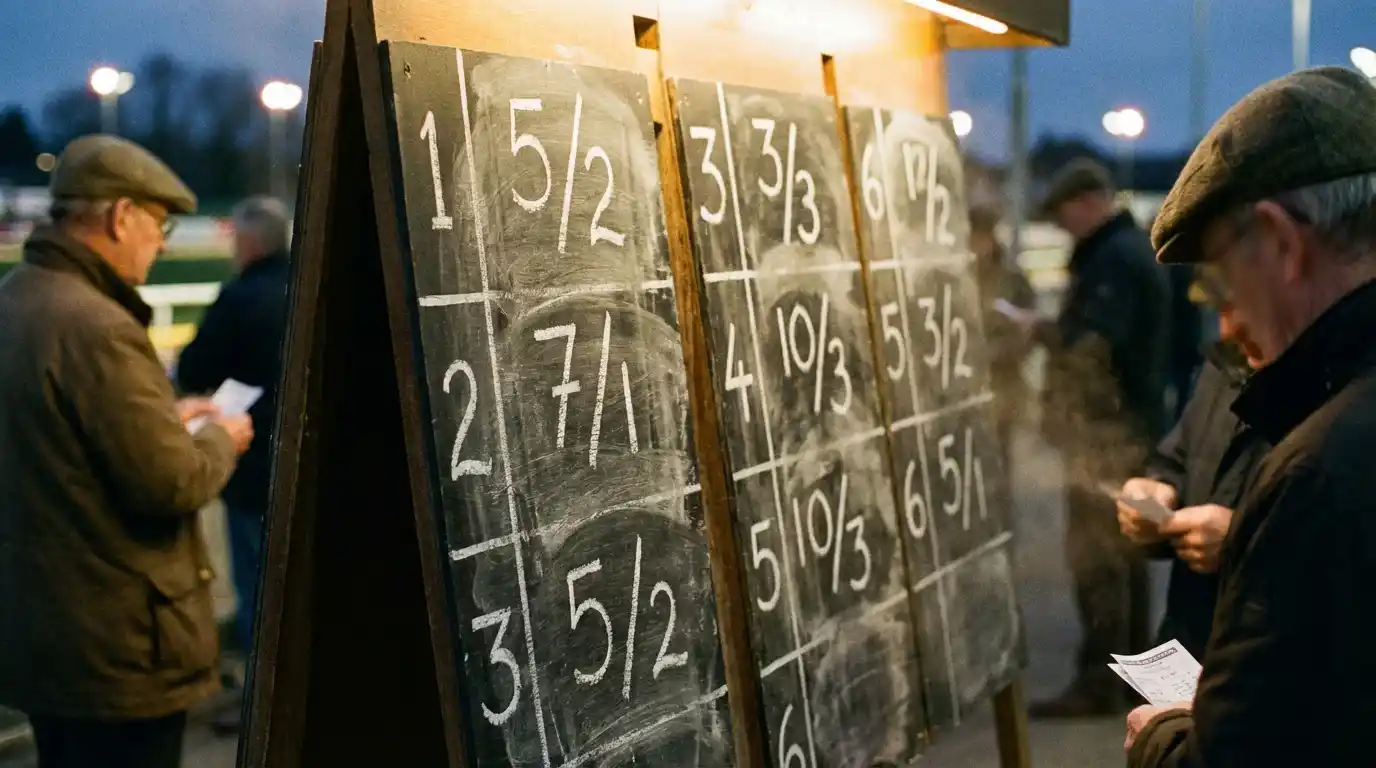
The SP is typically returned as a fractional odds figure — 3/1, 5/2, 7/4, and so on. The range of possible SPs follows a standard scale of traditional betting increments: 1/5, 2/7, 1/3, 2/5, 4/9, 1/2, 8/13, 4/5, 5/6, evens, 11/10, 5/4, 11/8, 6/4, 13/8, 7/4, 15/8, 2/1, 9/4, 5/2, 11/4, 3/1, and upward. Prices between these traditional points are rounded to the nearest standard increment.
One important technical detail: the SP is determined at the moment the traps open, not at the moment you place your bet. If you select SP as your price on a bet placed an hour before the race, you are accepting whatever the market decides at race time. That means you have no control over the price you receive. If heavy money comes in for another dog in the final minutes before the race, the entire market re-balances, and your selection’s SP may be longer or shorter than the early prices suggested.
The SP mechanism means that greyhound prices can move sharply in the minutes before a race. A sudden influx of money for one dog will cause others to drift, and the final SP may look very different from the early-morning tissue price. Punters who watch markets closely can sometimes spot these late movements and use them as intelligence — either confirming their existing view or raising a warning flag.
SP vs Early Price: Which to Choose
Taking an early price is a commitment. SP is a gamble on the market. The choice between the two is one of the most frequent decisions a greyhound punter makes, and getting it right over hundreds of bets has a measurable impact on long-term returns.
The case for taking an early price is strongest when you believe you have identified value that the wider market will eventually recognise. If you rate a dog more highly than its current price suggests, and you expect the price to shorten as other punters and the on-course market reach the same conclusion, locking in the early price captures that value before it evaporates. This is the core argument for early-price betting: you secure a better number than the one the market will eventually settle on.
The risk is that you are wrong — the market does not shorten, and the SP ends up longer than the price you took. In that scenario, you have committed to an inferior price. Without BOG, this is a straightforward loss of value. With BOG, the bookmaker upgrades your payout to SP, neutralising the downside. This is why BOG is so powerful for early-price punters: it converts the early-price decision from a two-sided risk into a one-sided opportunity.
The case for taking SP is strongest when the market is uncertain and you do not have a confident view on which way the price will move. In competitive races where the form is difficult to separate and the market is likely to see significant late movement, SP avoids the risk of committing too early to a price that drifts. SP also makes sense when you have a last-minute view — perhaps based on track conditions, a late scratching, or market intelligence observed in the final minutes before the off. In these cases, SP captures the most up-to-date market assessment.
A practical framework: take the early price when your conviction is high and the current odds represent value. Take SP when the race is genuinely open, when you are betting late, or when you lack a clear view on market direction. If BOG is available, the equation tilts heavily towards early prices, because the downside of taking a price that drifts is eliminated while the upside of securing value before it shortens is preserved.
One common trap is taking early prices for the sake of it — backing a dog at morning prices simply because the odds are available, without a genuine form-based reason to believe the price represents value. Early-price betting is only an advantage when you have an opinion worth locking in. If you are uncertain about a selection, waiting for more information (late market moves, track conditions, the appearance of the dogs at the parade) may be more profitable than committing early to a bet you are not confident about.
How BOG Links SP and Early Price
With BOG, you take the early price and get paid at whichever is higher — creating an asymmetric advantage that every greyhound punter should exploit.
Best Odds Guaranteed eliminates the main disadvantage of early-price betting. Without BOG, taking 4/1 in the morning means you are paid at 4/1 regardless of whether the SP is 3/1 or 6/1. With BOG, if the SP is 6/1, you are paid at 6/1. If the SP is 3/1, you keep your 4/1. The mechanism automatically selects the better of your two prices, ensuring you can never be disadvantaged by taking an early price.
This changes the decision framework fundamentally. Without BOG, the choice between early price and SP involves genuine trade-offs — the possibility of locking in value versus the risk of committing to a price that drifts. With BOG, the trade-off disappears on the downside. You can take the early price with confidence, knowing that if the market moves against you (the price drifts), you benefit; and if the market moves with you (the price shortens), you are already on at the better number.
The practical implication is that any greyhound punter with access to BOG should default to taking early prices whenever they have a selection they are confident in. The only reason to wait for SP when BOG is available is if you genuinely have no opinion yet and are waiting for late information to form your view. Once your opinion is formed and the price is acceptable, take it. BOG ensures you cannot lose the price comparison.
Not all bookmakers offer BOG on greyhounds, and the terms vary between those that do. Some restrict it to specific tracks, minimum odds, or maximum stakes. Check the conditions at your bookmaker before assuming BOG applies to your bet, because a bet you believed was BOG-protected settling at a worse price than SP is an avoidable frustration.
The Price That Closes the Market
SP is the final word — make sure you have already had yours. By the time the Starting Price is declared, the race is underway and the betting is closed. Whatever the SP turns out to be, it is the last assessment the market makes before the outcome is decided.
For punters, the SP serves two functions. It is the price at which SP bets are settled, and it is the reference point against which the quality of your early-price selections can be measured. If you consistently take early prices that are better than the eventual SP, you are demonstrating that your timing and market reading are sound — you are capturing value before the market catches up. If your early prices are consistently worse than SP, you are paying a premium for the privilege of betting early, which defeats the purpose.
Track your early prices against the SP over a sample of a hundred bets or more. The comparison will tell you whether your early-price strategy is working and whether you are genuinely better off taking prices in the morning or waiting for the market to settle. This data, combined with BOG awareness, will help you refine an approach that extracts the maximum value from the greyhound betting market — before the final word is spoken at the off.