
Greyhound Weight Changes: Do They Affect Form?
Best Greyhound Betting Sites – Bet on Greyhounds in 2026
Loading...
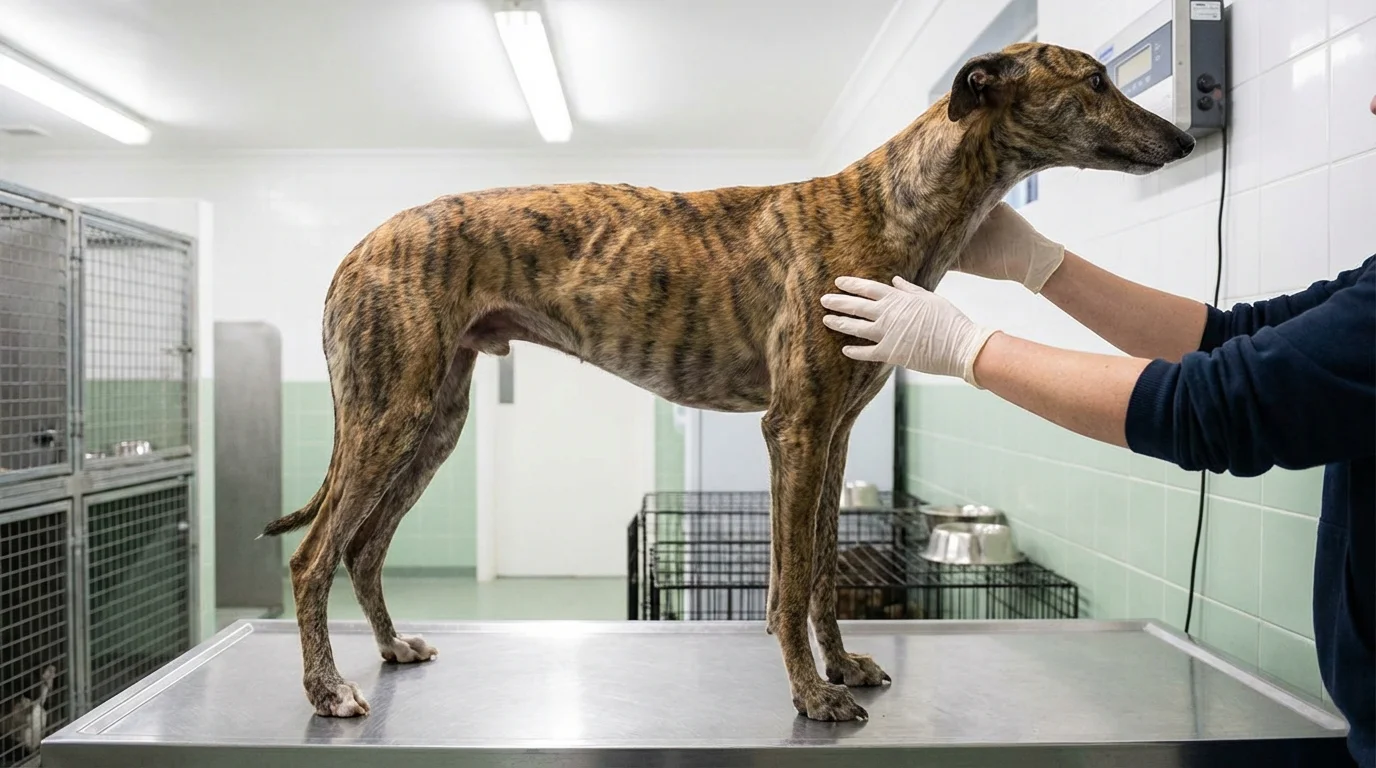
Weight on the Card: Signal or Noise?
Every race card lists the dog’s weight — but knowing what to do with it is another matter. Weight is one of those form factors that generates strong opinions among experienced greyhound punters and complete indifference among newcomers. Both reactions miss the mark. Weight data is neither the key to picking winners nor irrelevant noise. It sits somewhere in between: a secondary indicator that occasionally provides a useful edge, and more often confirms what other form factors are already telling you.
A greyhound’s racing weight is recorded before every race, typically in kilograms to one decimal place. The figure appears on the racecard alongside the dog’s name, trap number, and recent form. Most punters glance at it, note whether it looks roughly normal, and move on. The ones who pay closer attention look for changes — differences between the current weight and the weight recorded in recent outings. It is these changes, rather than the absolute number, that carry analytical value.
Greyhounds are lean, muscular athletes whose racing weight tends to be remarkably stable during periods of regular competition. A dog that races every week at 32.4 kilograms is in a settled routine, and small fluctuations of 0.1 or 0.2 kilos in either direction are normal and unimportant. The signal comes when the change is larger, more sudden, or breaks an established pattern. Then the weight column is telling you something — the question is what.
The honest answer is that weight data alone is ambiguous. A significant gain might mean the dog is reaching peak fitness or might mean it is carrying surplus condition. A sharp loss might indicate race sharpness or might indicate stress. To extract meaning from weight changes, you need context from other form indicators: recent race performance, grade, time since last run, and trainer patterns. Weight is a clue, not a verdict.
When Weight Changes Matter
A kilo either way is noticeable. Two kilos is a red flag. Those thresholds are rough but useful guidelines for identifying weight changes that warrant further investigation.
To understand why, consider the physical reality. A racing greyhound typically weighs between 26 and 36 kilograms, depending on sex and build. At those body weights, a one-kilogram change represents approximately 3% to 4% of total body mass. In human athletic terms, that is equivalent to a 75-kilogram runner gaining or losing over two kilograms between competitions — a change that any coach would notice and investigate. Greyhounds do not have coaches flagging these shifts for the public, but the data is there on the racecard for anyone willing to look.
A weight gain of 0.5 to 1.0 kilograms from a dog’s recent racing weight is relatively common and can indicate several things. If the dog has been off the track for two or more weeks — perhaps resting between competitions or recovering from a minor issue — a small gain is normal and often represents a return to full fitness. The dog has been fed well, rested, and may be in better physical condition than its most recent race suggests. In these cases, the gain is neutral to mildly positive.
A weight gain above 1.0 kilogram, particularly if the dog has been racing regularly, is more concerning. It may indicate that the dog is not being trained as intensely, or that it is carrying excess condition that could slow it down. A heavy dog is a sluggish dog, and the difference between racing at 31.5 and 32.5 kilograms can be several lengths over 480 metres — the equivalent of a full body length or more in a tight finish.
On the other side, a weight loss of 0.5 kilograms or more from a stable baseline is worth noting. A slight loss often indicates that the dog is race-fit and lean — carrying less surplus mass and potentially sharper than when it was heavier. This is particularly true for dogs returning from a break that initially came back heavy and have been gradually trimming down with regular racing. The downward trend suggests the trainer is bringing the dog to peak condition.
A sharp loss exceeding 1.0 kilogram is different. If a dog has dropped a kilo or more between successive races without an obvious explanation — no break, no change of trainer, no recent illness reported — it may signal stress, dehydration, or an underlying health issue. Dogs in this category often underperform, and the weight loss is a warning sign that the form book may not yet reflect.
Common Weight Patterns and What They Suggest
Gradual gain often means peak fitness. Sharp loss rarely means anything good. Those are the two anchor observations around which most useful weight analysis revolves.
The post-break pattern is the most common and the easiest to interpret. A dog returns from a two-to-four-week break carrying an extra kilo or so. Over its first two or three races back, the weight gradually drops back to its previous racing level. The first race back is often a prep run — the dog may not win, but the weight trend suggests improvement is coming. By the third or fourth race back, the dog is at its fighting weight and ready to perform. This pattern is so consistent that some punters specifically target dogs on their second or third run after a break, expecting both form and fitness to peak simultaneously.
The seasonal pattern is subtler but equally real. Greyhounds tend to be slightly heavier in winter months when they are less active and retaining more body mass for warmth. As the warmer months arrive, they naturally lean out. A dog that races in January at 33.0 kilograms and in June at 32.2 is following a typical seasonal curve. Do not read too much into weight differences across seasons — compare like with like by assessing weight changes within the same period of the year.
The age-related pattern is a longer-term trend. Young greyhounds entering their racing career tend to gain weight steadily as they mature and build muscle. A dog in its first racing season might gain a kilogram over six months simply through physical development, and this gain usually correlates with improving performance. Older dogs, by contrast, may lose weight gradually as they age out of peak condition. A veteran dog that is consistently lighter than it was a year ago might be losing muscle mass, which is rarely a positive sign for future performance.
The erratic pattern is the most concerning. A dog whose weight fluctuates unpredictably — up a kilo one week, down half a kilo the next, back up again — may be dealing with an inconsistent training regime, dietary issues, or low-level health problems. Erratic weight is a correlate of erratic form, and dogs in this category are poor betting propositions regardless of their raw times.
Track these patterns by noting the weight from a dog’s last four to six races and looking for the trend. A stable or gradually trending line is reassuring. A volatile line is a caution signal. The calculation takes seconds but can prevent you from backing a dog whose body is not quite right.
How to Use Weight Data in Your Selections
Weight alone will not pick a winner — but it can eliminate a loser. That is its practical role in a selection process, and treating it as a filter rather than a foundation is the approach that works.
Build your shortlist using form, grade, trap draw, and running style — the primary variables. Then check the weight column for each dog on your shortlist. If a dog you fancy has a stable or improving weight profile, proceed with confidence. If it has gained or lost significantly from its recent baseline, pause and investigate. The weight change may have a benign explanation — or it may be the first signal of a problem that will manifest in the race.
Weight data is particularly useful in separating two closely matched dogs. If you have narrowed a race to two candidates and their form, grade, and draw look similar, the weight trend can be the tiebreaker. The dog that is leaner and trending towards its optimal racing weight has a physical edge over the dog that is heavier than usual or showing erratic fluctuations.
One caution: do not over-weight the weight data. It is tempting, once you start paying attention to it, to read significance into every 0.2-kilogram shift. That way lies over-analysis. Small fluctuations are normal, and no dog weighs exactly the same at every race. Focus on meaningful changes — a kilo or more from baseline, a clear upward or downward trend, or a pattern that breaks from the norm. Everything else is noise, and good analysis means knowing when to disregard noise as much as when to act on signals.
The Scale Doesn’t Lie, but It Doesn’t Tell the Whole Truth
Weight is context, not conclusion. A number on the racecard that changes from one week to the next is a data point, and like all data points, it only becomes meaningful when placed alongside the full picture of a dog’s form, fitness, and competitive environment.
The punters who use weight data well are the ones who integrate it quietly into their process without letting it dominate. They notice when a dog is heavier than usual. They note the post-break pattern of gradual weight reduction. They raise a flag when a sharp loss appears on an otherwise stable dog. But they never back or oppose a dog based on weight alone — because a 32-kilogram dog in the right grade, from the right trap, with the right running style, will beat a 31-kilogram dog that lacks those advantages every time.
Make it a habit to record the weight of every dog you bet on, alongside the result. Over a few months, your own data will tell you whether weight changes are a useful predictor in your specific betting niche — the tracks you follow, the grades you bet in, the types of races you target. For some punters, weight becomes a reliable secondary filter. For others, it adds little. The only way to find out which camp you fall into is to track it and let the numbers decide.