
Market Comparison: Greyhound vs Horse Racing Betting
Best Greyhound Betting Sites – Bet on Greyhounds in 2026
 Available in US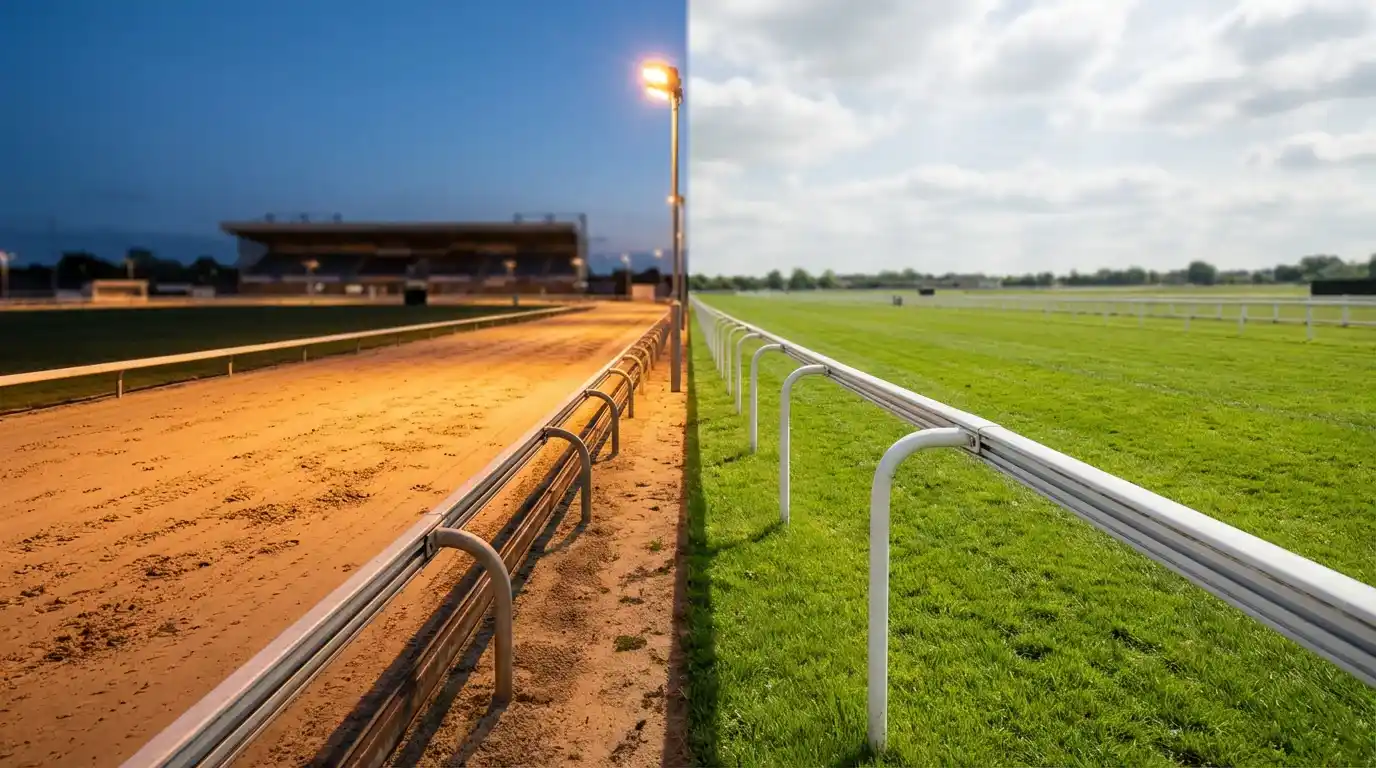
Comparing Greyhound Betting Markets vs Horse Racing
Greyhound racing and horse racing share a finish line — but very little else. The two sports are often grouped together under the umbrella of “racing,” and many punters drift between them without fully appreciating how fundamentally different they are as betting propositions. The field sizes, the form variables, the market dynamics, and the pace of betting are all distinct, and the punter who applies horse racing instincts to greyhound racing without adjustment is likely to underperform in both.
This is not a question of which sport is better. Both offer genuine opportunities for informed punters, and many serious bettors maintain an interest in both. But the skills that make you profitable on the Flat at Ascot do not automatically transfer to a Tuesday evening at Romford, and understanding why is the first step to becoming effective in both arenas.
Field Size and Its Effect on Betting
Six dogs versus fourteen horses changes the maths fundamentally — and the maths changes everything that follows.
A standard greyhound race has six runners. A typical horse race can have anywhere from six to twenty or more, with major handicaps featuring large fields — the Grand National, for example, had a maximum of 40 runners until the field was reduced to a maximum of 34 from 2024. This difference in field size is the single most important structural distinction between the two sports from a betting perspective, because it cascades into every aspect of odds, probability, and market dynamics.
In a six-dog greyhound race, the favourite has a theoretical fair-share probability of 16.7% before any form analysis is applied. In practice, greyhound favourites win around 33% to 35% of the time — roughly double the random expectation. In a fourteen-runner horse race, the favourite’s fair-share probability is just 7.1%, and actual favourite win rates of 30% to 35% represent an even larger multiple above random chance. But the key difference is what happens beyond the favourite. In a six-dog race, even the biggest outsider has a realistic chance of finishing in the frame. In a twenty-runner horse race, the tail of the field — the dogs at 33/1 and longer — are genuinely unlikely to feature.
Smaller fields make forecasts and tricasts more viable in greyhound racing. Predicting the first two from six runners is a fundamentally more achievable task than predicting the first two from fourteen. This is why forecast betting is a core part of greyhound strategy in a way that it is not for most horse racing punters. The permutations are manageable, the probabilities are higher, and the dividends — while less spectacular than the occasional horse racing jackpot — are more consistent.
The flip side is that smaller fields mean shorter odds on average. A greyhound favourite at 2/1 is common; a horse racing favourite at 2/1 often means a small field or a dominant market leader. For punters seeking big-priced winners, horse racing offers more frequent opportunities simply because the larger fields produce more variance and more surprises.
Form Factors: What’s Different
No jockey. No weight cloth. No going stick. Greyhound form is purer in some respects — and more limited in others.
The most significant difference is the absence of a human rider. In horse racing, the jockey’s skill, tactics, and decisions add a layer of complexity that does not exist in greyhound racing. A jockey can misjudge the pace, get boxed in, make a premature challenge, or deliver a perfectly timed run — all of which affect the result independently of the horse’s ability. In greyhound racing, there is no such intermediary. The dog runs on instinct, and its performance is a more direct expression of its physical ability and racing temperament. This makes greyhound form arguably more reliable as a predictor of future performance, because there is one fewer variable to account for.
Weight is a significant factor in horse racing — jockeys carry assigned weights, and the allocation can materially affect a horse’s performance. Greyhound racing has no weight variable in this sense. A dog’s body weight is recorded but not artificially adjusted, and while weight changes can indicate fitness (as discussed elsewhere), there is no external weight penalty imposed on better performers.
Going — the condition of the racing surface — is a major variable in horse racing, where the difference between firm and heavy ground can transform the form book. Greyhound racing surfaces are more consistent: all UK tracks use sand, and while weather affects conditions, the range of variation is narrower than in horse racing. A horse that loves soft ground and hates firm is a radically different proposition depending on the weather. A greyhound on a wet sand surface versus a dry one is affected, but less dramatically.
On the other hand, greyhound form analysis has fewer data points to work with. Race comments are briefer, sectional timing is less widely available, and the analytical infrastructure — ratings, speed figures, pedigree databases — is less developed than in horse racing. The greyhound punter works with a leaner data set, which means each piece of information carries more weight and the ability to extract insight from replays and race comments becomes more important.
Markets, Coverage, and Availability
Horse racing gets the TV time. Greyhounds get the volume. The two sports occupy different positions in the UK betting landscape, and those positions affect market depth, pricing efficiency, and the availability of value.
Horse racing is broadcast extensively on terrestrial and satellite television, covered in depth by national newspapers, and supported by a large ecosystem of tipsters, form analysts, and media commentators. This attention drives high betting volumes, particularly on feature races like Royal Ascot, the Cheltenham Festival, and the Grand National. The result is deep, efficient markets where pricing errors are corrected quickly and the bookmaker’s margin is compressed by competition.
Greyhound racing receives far less media coverage but offers far more racing. UK greyhound tracks host meetings most evenings of the week and on weekend afternoons, producing a volume of races that dwarfs the horse racing calendar. A busy greyhound evening might feature sixty or more races across multiple tracks, each one a betting opportunity. The sheer volume means that bookmaker traders have less time to price each race carefully, and the market attention per race is lower. For the informed punter, this combination of high volume and low scrutiny creates more frequent pricing inefficiencies than the closely watched horse racing market.
Exchange liquidity is significantly lower for greyhound racing than for horse racing. Major horse racing events generate millions of pounds in exchange turnover; even popular greyhound meetings generate a fraction of that. This matters for exchange-based strategies like lay betting and trading, where liquidity determines whether your bets can be matched at your desired price. Greyhound exchange betting is viable but limited to the more popular meetings; horse racing exchange betting is viable across a much wider range of events.
Which Suits Your Betting Style?
If you want data-driven simplicity, greyhounds. If you want depth and narrative, horses. That is the broadest summary, though the reality is more nuanced.
Greyhound racing suits punters who prefer smaller fields, faster decision-making, higher racing frequency, and a form-analysis process that is data-driven but compact. The six-runner fields mean fewer variables per race, the short race distances mean outcomes are decided quickly, and the evening meeting schedule fits around work and other commitments. Greyhound punters can develop track-specific expertise relatively quickly because the grading and field structures are more standardised.
Horse racing suits punters who enjoy larger fields, deeper form analysis, seasonal narratives (two-year-old potential, Classic trials, festival form), and a richer media ecosystem. The form-analysis process is more involved — jockey bookings, trainer patterns, ground preferences, weight allocations, pedigree angles — and the range of bet types and markets is broader. Horse racing rewards punters who enjoy research for its own sake and who derive satisfaction from the analytical depth the sport requires.
Different Dogs, Different Horses
Both sports reward the prepared punter — just in different ways. The greyhound bettor who understands trap draw, running style, and grading has a genuine edge in a market that receives less public scrutiny. The horse racing bettor who masters going preferences, jockey-trainer combinations, and speed figures has a genuine edge in a market that is deeper and more extensively covered.
There is no reason to choose one over the other. The skills are complementary — an understanding of probability, value, staking discipline, and market dynamics applies equally to both. What changes is the specific knowledge required to generate an opinion worth backing. If you currently bet only on one sport and are curious about the other, the best advice is to start by watching, not betting. Spend a few weeks studying the form, watching the races, and developing a feel for the sport before putting money at risk. The learning curve is shorter than you might expect, and the second sport will sharpen your thinking about the first.
