Greyhound Trap Draw: Does Trap Position Matter?
Best Greyhound Betting Sites – Bet on Greyhounds in 2026
Loading...
Trap 1 to Trap 6: The Draw Nobody Ignores
Every greyhound punter has an opinion on traps — most of them are based on myth rather than data. The conviction that trap 1 is a golden ticket, or that trap 6 is a death sentence, persists despite the numbers telling a far more nuanced story. Trap draw matters in greyhound racing. It just does not matter in the way most people think.
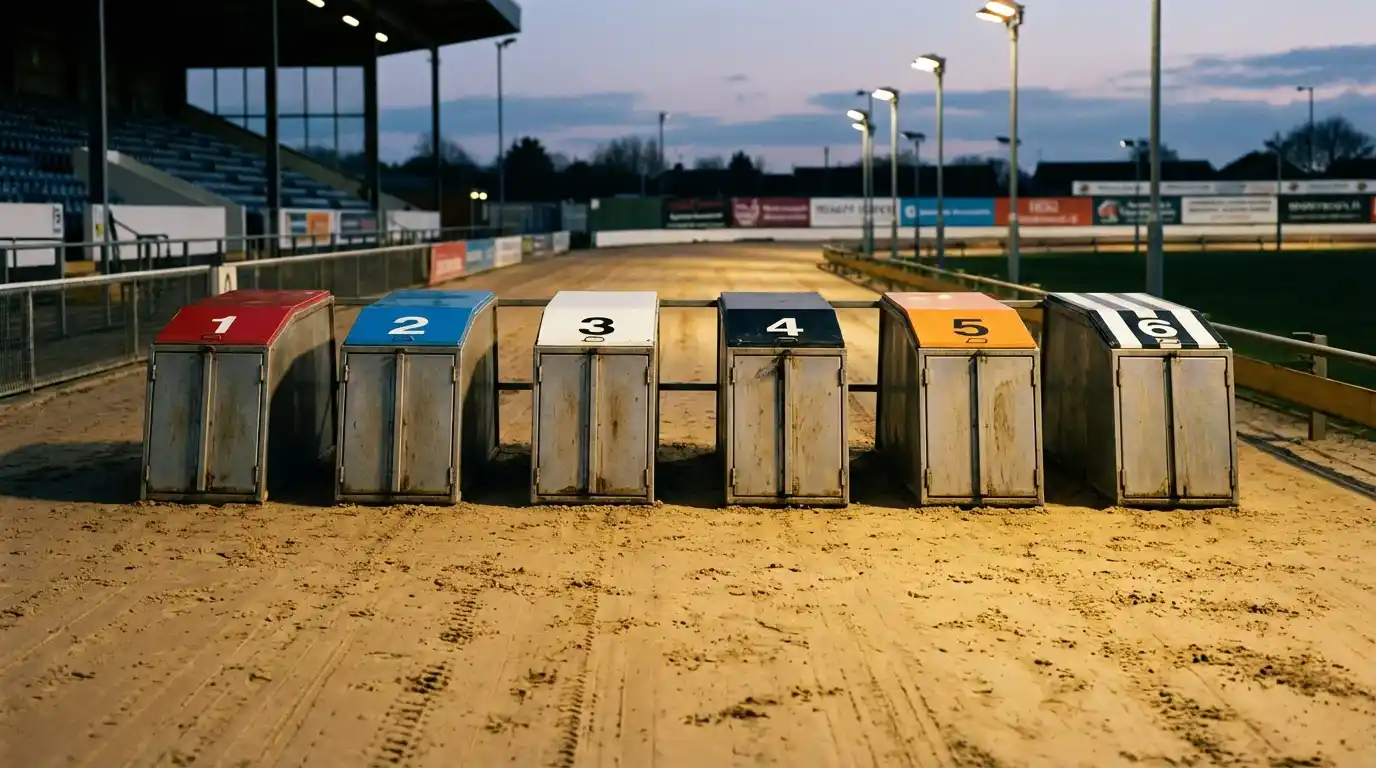
At a basic level, greyhound races in the UK feature six runners starting from numbered traps — trap 1 on the inside of the track, trap 6 on the outside. Each trap corresponds to a coloured racing jacket: red for 1, blue for 2, white for 3, black for 4, orange for 5, and black-and-white stripes for 6. When the lids open, the dogs burst forward and converge on the first bend, which is typically the most chaotic and decisive moment of the race. Where a dog starts relative to that bend shapes its initial racing position, and by extension, its chance of avoiding trouble and maintaining momentum.
The reason trap draw generates such strong opinions is that punters can see its effect. A dog in trap 1 takes the shortest route to the first bend. A dog in trap 6 has the widest arc. That visual difference creates an instinctive belief that inside traps are better. And in aggregate, the data supports a mild version of that belief — but the margins are far smaller than most assume, and the reality is complicated by running styles, track geometry, and field composition.
What the Data Says About Trap Advantage
Trap 1 does win more often — but not by as much as most punters think. Aggregated UK greyhound racing statistics consistently show that trap 1 has a win rate somewhere between 18% and 22% across most tracks, compared to a theoretical fair share of 16.7% in a six-runner field. That is an advantage, but it is a modest one — roughly two to five percentage points above average.
Traps 2 and 6 often show the next highest win rates, though this varies significantly by track. Trap 6, despite being on the outside, benefits from having only one dog beside it — like trap 1, it faces less immediate crowding at the break. The middle traps, particularly 3 and 4, tend to have the lowest win rates in aggregate because they face potential interference from both sides at the first bend.
Here is an approximate guide to what typical UK trap win percentages look like across a large sample:
| Trap | Typical Win Rate | Relative to Fair Share |
|---|---|---|
| 1 (Red) | 18–22% | Above average |
| 2 (Blue) | 16–19% | Around average |
| 3 (White) | 14–17% | Below average |
| 4 (Black) | 14–17% | Below average |
| 5 (Orange) | 15–18% | Around average |
| 6 (Stripes) | 16–20% | Around or above average |
These figures are generalisations. The actual percentages fluctuate meaningfully by track, by distance, and by sample period. A track with a short run to the first bend will amplify the inside advantage because dogs in traps 1 and 2 reach the bend before the outside runners can establish position. A track with a long run-up before the first turn gives the outside traps more time to find their racing line, reducing the inside bias.
The critical point for bettors is that trap advantage is real but marginal. A two-percentage-point edge is not nothing, but it is not enough to base a selection on in isolation. The dog in trap 1 still loses roughly four out of five races. If that dog also has poor recent form, an unsuitable running style for the track, or is stepping up in class, the trap advantage is irrelevant. Trap draw is a tiebreaker, not a trump card.
How Running Style Interacts With Trap Draw
A railer in trap 6 is a dog in trouble before the lids even open. That mismatch between running style and trap position is where the real analytical value in draw analysis lies — not in the raw trap numbers, but in how individual dogs respond to where they start.
Greyhound racecards typically denote a dog’s running preference with a letter after its name: (R) for railer (prefers the inside), (M) for middle runner, and (W) for wide runner (prefers racing on the outside of the track). These designations reflect how the dog behaves in races — where it naturally gravitates once the initial break settles down.
A railer drawn in trap 1 is in the ideal position. It can hug the inside rail from the start, take the shortest route to the first bend, and maintain its preferred racing line throughout. A railer drawn in trap 5 or 6, however, has to cross the path of four or five other dogs to reach the rail — a manoeuvre that invites interference, wastes energy, and often results in losing several lengths before the first bend is even reached.
The reverse applies to wide runners. A dog designated (W) is comfortable racing in the middle or outside of the pack. Drawn in trap 5 or 6, it can break cleanly and sweep wide around the first bend without needing to cross traffic. Drawn in trap 1, it may find itself boxed in against the rail with no room to adopt its natural style, leading to a crowded and uncomfortable run.
Middle runners are the most adaptable and therefore the least affected by trap draw. They can operate from most positions without major disadvantage, which is why (M) dogs are often undervalued by punters who fixate on inside traps.
The smartest approach to trap draw analysis is not to ask which trap is best in general, but to ask which trap is best for this specific dog. A wide runner drawn in trap 6 may have a bigger advantage than a railer drawn in trap 1 if the railer is returning from injury or facing a class rise. The trap-style match is what matters — the raw trap number is just the starting point of that assessment.
When you study form, note which trap each dog ran from in its recent races and how it performed relative to its running style. A dog that has won three times from trap 2 but never placed from trap 5 is telling you something about its preference. That data is on the racecard if you know where to look.
Why Trap Bias Varies by Track
Trap bias is a track-specific phenomenon, not a universal law. What works at Romford may be misleading at Towcester, and the reasons are physical rather than statistical.
The key variable is the distance from the traps to the first bend. At tracks where this run is short — sometimes as little as 30 or 40 metres — the inside traps gain a disproportionate advantage because dogs on the outside simply do not have enough ground to establish a position before the field converges on the turn. At tracks with a longer run to the first bend, the field has time to sort itself out, and the trap advantage diminishes.
Track geometry matters, too. The tightness of the bends, the camber of the turns, and the overall circumference of the circuit all influence how much benefit the inside line confers. A tight track with sharp bends magnifies the inside advantage. A galloping track with sweeping curves reduces it.
Sand quality and depth can also play a subtle role. Tracks where the inside running line is more compacted — from heavier use or different drainage — may produce faster times for dogs running close to the rail. This is not something you will find in official statistics, but regular attendees at specific tracks often develop a feel for it.
The practical implication is clear: if you are going to use trap bias in your betting, you need track-specific data, not national averages. Check the trap statistics for the track hosting the meeting you are betting on, ideally over a recent sample of at least a few hundred races. The Greyhound Board of Great Britain publishes some of this data, and several independent tipping sites maintain track-by-track trap records. If the data shows trap 5 has won 22% of races at a particular track over the past year while trap 3 has won only 12%, that is a meaningful bias worth incorporating into your analysis.
The Trap Is Just the Starting Point
Draw matters — but it is one factor among many, and not the whole story. Punters who build their entire selection process around trap numbers are optimising for a variable that accounts for perhaps 5% to 10% of race outcomes. The other 90% is form, running style, class, fitness, trainer intent, and the chaos that six athletes running at up to 45 miles per hour inevitably generate.
The best use of trap draw analysis is as a filter, not a foundation. Start with your form assessment. Identify the dogs you rate on ability. Then check whether the trap draw supports or undermines each selection. A dog you rate highly that also has a favourable draw is a strong candidate. A dog you rate highly that is poorly drawn might still be worth backing — but at slightly reduced confidence, or at a higher price to compensate for the draw disadvantage.
Avoid the common mistake of dismissing a good dog because of a poor draw. Greyhound racing produces enough upsets from awkward traps to make clear that ability trumps position more often than not. The statistics on trap win rates are probabilities, not certainties, and a three-percentage-point disadvantage is nowhere near enough to write off a dog with superior form.
Where trap analysis genuinely earns its keep is in marginal decisions. Two dogs of similar ability, similar recent form, running at the same grade — and one has a draw that suits its style while the other does not. That is where the trap column on the racecard tips the balance. Not as the main reason for a bet, but as the final piece of evidence in a decision that was already close.