Greyhound Early Speed vs Closers: Running Styles
Best Greyhound Betting Sites – Bet on Greyhounds in 2026
Loading...
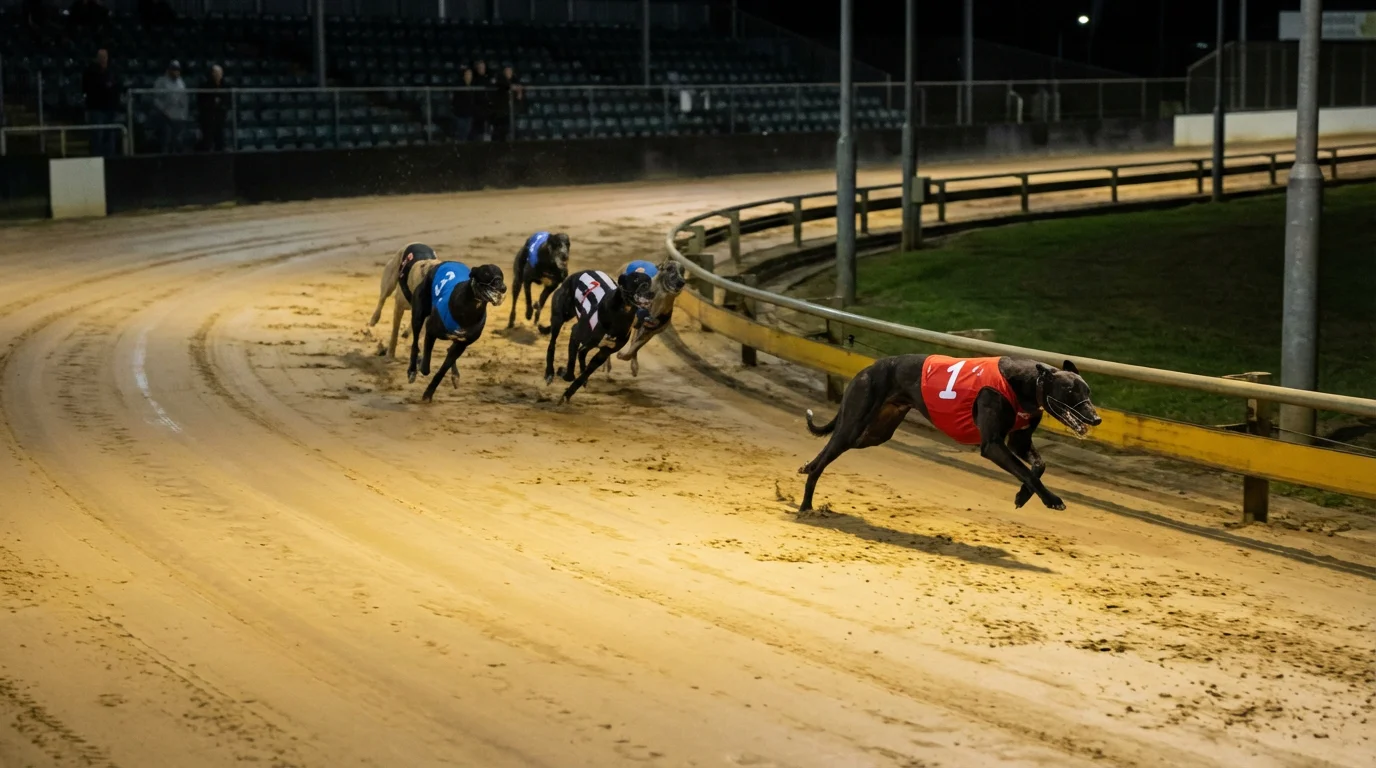
The Race Starts Before the First Bend
The lids open, six dogs burst forward — and the one who leads at the first bend wins more often than any other. That statistical reality is the foundation of greyhound running-style analysis, and ignoring it means ignoring the single most predictive piece of the race puzzle.
Running style in greyhound racing describes how a dog typically races — where it positions itself in the field and how it distributes its effort over the course of the race. Some dogs explode out of the traps and look to lead from the first stride. Others settle in the pack and attempt to overhaul tiring leaders in the closing stages. Between those extremes sit the mid-race runners, dogs that hold a position in the middle of the field and rely on a combination of pace and positioning to finish well.
Unlike horse racing, where a jockey can adjust tactics mid-race, greyhounds run on instinct. A dog that habitually breaks fast will break fast every time. A closer will always be slow out of the traps and look to finish strongly. These patterns are deeply ingrained, which makes them remarkably reliable for form analysis. A dog does not suddenly become a front-runner after a career of coming from behind, and a habitual leader does not decide to sit at the back of the pack and wait.
For bettors, this consistency is a gift. Running style is one of the few variables in greyhound racing that genuinely repeats, making it a dependable input in your selection process.
Early Pace, Mid-Race Runners, and Closers
Three styles, three tactical profiles — and the track decides which one wins most often.
Early-pace dogs are the front-runners. They break sharply from the traps, aim to lead at the first bend, and try to maintain their advantage through the remainder of the race. On the racecard, their recent form comments will typically include phrases like “led from trap,” “always prominent,” or “disputed lead.” Their positional history — the column showing where the dog sat at each bend — will show 1 or 2 at the first timing point. These dogs thrive on clean breaks and uncontested leads. Their ideal scenario is to reach the first bend in front with daylight between them and the field, then control the pace from there. Their worst scenario is to be challenged for the lead by another fast-break dog, because the resulting battle wastes energy and opens the door for closers.
Mid-race runners sit in the pack during the early stages and look to pick off tiring dogs in the second half of the race. They break reasonably well — not leading, but not trailing — and rely on sustained pace rather than explosive speed. On the form card, their positional figures might show 3 or 4 at the first bend and 2 or 3 at the second. These are often the most difficult dogs to assess because their performance depends heavily on the pace of the race around them. In a fast-run race where the leaders tire, mid-runners can pick up the pieces. In a steadily run race where the leader controls things comfortably, mid-runners may never find the gap to improve their position.
Closers are the dogs that come from behind. They break slowly, sit at the back of the field for most of the race, and produce a finishing burst in the final straight. Their form figures typically show 5 or 6 at the first bend and 3 or 4 at the finish — or, on a good day, 1 or 2. Closers are exciting to watch but frustrating to back consistently, because their success depends on interference ahead of them. If the leaders run cleanly and maintain their position, the closer never gets close enough to strike. Closers win by exploiting trouble — bumps, crowding, fading pace — and trouble is, by definition, unpredictable.
These designations are not absolute. Some dogs can show early pace when drawn on the inside and closing speed when drawn wide. But the broad tendencies are consistent enough to use as a reliable analytical tool across most races.
What the Numbers Say About Early Speed
Leading at the first bend correlates with winning more than any other single factor in greyhound racing. The data across UK tracks is remarkably consistent: dogs that lead at the first timing point win somewhere between 35% and 45% of races, depending on the track and distance. Given that these dogs represent just one-sixth of the field at the start, that conversion rate is striking.
The reasons are physical and structural. A greyhound that leads at the first bend has, by definition, avoided the worst of the crowding that affects the pack behind. It has a clear run ahead and can pick its racing line without negotiating other dogs. It also benefits from a psychological element — greyhounds are coursing animals that instinctively chase what is in front of them. A leader sets the pace and the field follows, which means the leader dictates the terms of the race.
The interference factor is the most significant. Greyhound racing at the first bend is often chaotic. Six dogs converging on a relatively tight turn produces bumping, checking, and loss of momentum for dogs caught in traffic. The leader avoids most of this. The closer, at the back of the field, may avoid it too — but the closer then has five lengths to make up on the leader, and the track distance may not be long enough for that.
Distance matters here. Over sprint trips of 280 to 380 metres, early speed is overwhelmingly dominant because there simply is not enough ground for closers to recover lost lengths. Over middle-distance and staying trips above 550 metres, the advantage shifts slightly — closers have more time and distance to make their run, and leaders can tire if they have used too much energy in the early stages. Even at staying distances, though, the dog that leads at the first bend retains a statistical advantage over the field.
For punters, the implication is straightforward: identify the likely leader in every race. Check which dog has the best early-pace record, consider the trap draw (inside traps help front-runners reach the bend first), and assess whether any other dog in the field is likely to challenge for the early lead. A race with one clear leader and five dogs that prefer to come from behind is significantly more predictable than a race with three dogs that all want to be in front.
How Running Styles Clash in a Race
Two fast-break dogs in trap 1 and trap 2 means trouble for both — and opportunity for the rest of the field. The interaction between running styles within a race is where the form analysis moves from individual assessment to race-shape prediction, and that shift is what separates good punters from average ones.
When two or more dogs with early pace are drawn alongside each other, they are likely to compete for the lead at the first bend. That competition slows both down, uses extra energy, and often results in physical contact that compromises their runs. Meanwhile, a closer sitting at the back avoids the carnage entirely and may find a clear path to challenge in the home straight. This is why race composition — the mix of running styles in the field — matters as much as individual ability.
The ideal scenario for a front-runner is to be the only early-pace dog in the race. No challenge for the lead, a clean break, and a free run to the line. When you see this on the racecard, it is one of the most reliable betting signals in greyhound racing. A lone front-runner from a favourable trap draw wins at a rate significantly above average, because its key advantage — avoiding interference — is virtually guaranteed.
Conversely, when every dog in the field has early pace, the race becomes a mess of crowding at the first bend and the result is closer to random than form would suggest. These races are best avoided from a betting perspective unless you can identify one dog with enough raw speed to lead despite the challenge, or one closer with enough quality to capitalise on the inevitable scrimmaging ahead.
Studying how running styles interact also helps you read past form more accurately. If a dog finished last in its previous race, check the race comments. Did it get crowded at the first bend because two faster-breaking dogs beside it converged on its space? If so, the poor finish was a product of circumstance rather than ability — and if today’s race offers a cleaner draw with less early-pace competition, the dog may outperform its recent form significantly.
Speed Gets You Clear, but the Race Is Six Dogs Deep
The best greyhound in a race is not always the fastest — it is the one that gets the clearest run. That distinction is central to understanding why greyhound racing produces upsets more frequently than a pure speed contest would, and why running-style analysis is as important as time analysis.
Raw speed is testable. You can compare times, calculate sectional splits, and rank dogs by measured ability. But the race is not a time trial. It is a six-dog event where physical proximity, interference, and luck of the running inject randomness that no form study can fully predict. A dog with the fastest time in the field can finish last if it is bumped off its stride at the first bend. A slower dog can win if it finds daylight while the fast ones are tangled up behind.
Running-style analysis does not eliminate this randomness, but it helps you assess its probability. By understanding which dogs are likely to lead, which will sit in behind, and which will try to close, you can sketch a probable race shape before the traps open. That sketch will not always be accurate — greyhound racing is too fast and too physical for certainty — but it gives you a framework for evaluating where value lies in the market.
The punters who consistently profit from greyhound racing are the ones who think about race shape as a whole, not just individual dogs in isolation. They ask: who leads? Who gets a clean run? Who is drawn badly relative to their style? Who benefits if the leader is challenged? These questions do not have definitive answers, but asking them is what moves your analysis from simple form reading to genuine race prediction.