Each Way Betting on Greyhounds Explained
Best Greyhound Betting Sites – Bet on Greyhounds in 2026
Loading...
Each Way: Two Bets in One Stake
Each way sounds like a safety net — but it has its own maths, and those numbers do not always work in your favour. Understanding when each way protects your bankroll and when it quietly erodes it is one of the most underrated skills in greyhound betting.
An each way bet is two separate bets bundled together. The first is a win bet: your dog must finish first for this part to pay out. The second is a place bet: your dog must finish in one of the designated place positions. In UK greyhound racing, place terms are almost universally two places — first or second — at a quarter of the win odds. This means a £10 each way bet costs £20 in total: £10 on the win, £10 on the place.
If your dog wins, both parts pay. You receive the full win odds on your win stake, plus quarter odds on your place stake. If your dog finishes second, only the place part pays — you lose the win stake but recover something from the place bet. If your dog finishes third or worse, you lose both stakes entirely.
The appeal is intuitive: you get paid even if your dog does not quite win. But that intuition hides a cost. Your total outlay is double a straight win bet, and the place return at quarter odds is often modest. Whether the safety net justifies the extra cost depends entirely on the odds of your selection — and most punters do not run those numbers before placing the bet.
Place Terms in UK Greyhound Racing
Two places. Quarter odds. That is the deal at virtually every UK bookmaker for standard greyhound races, and it is worth understanding exactly what that means in practice.
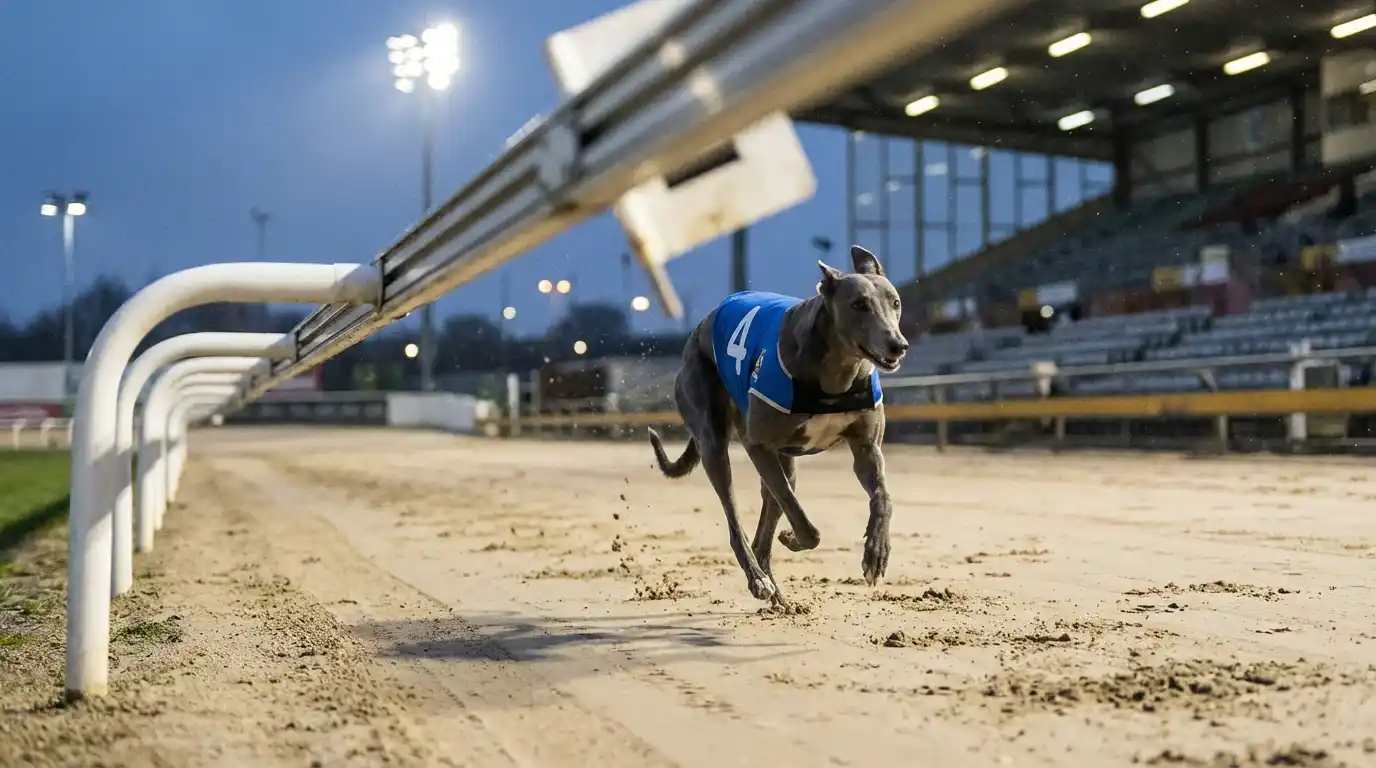
With six runners in a typical greyhound race, the place terms are tighter than in horse racing, where fields of twelve or more runners often offer three or four places. In greyhounds, only first and second count as placed finishes. Your dog needs to be in the top two — a third-place finish, no matter how close, returns nothing on the place portion.
The quarter-odds component works as follows: if your selection is priced at 8/1 to win, the place odds are 2/1 (one quarter of 8/1). At 4/1, the place odds become evens (1/1). At 2/1, the place odds drop to 1/2. At evens (1/1), the place odds are just 1/4 — barely enough to recover a fraction of your outlay.
Some bookmakers occasionally offer enhanced place terms for specific races or promotions — extra places, one-third odds instead of quarter, or paying on three places. These promotions can shift the maths significantly in the punter’s favour and are worth watching for, particularly on feature races like the Greyhound Derby or the St Leger. However, for day-to-day graded racing, standard terms of two places at quarter odds are the norm.
The two-place restriction is what makes greyhound each way betting fundamentally different from horse racing each way. In a twenty-runner horse race with five places, the place element has genuine standalone value. In a six-runner greyhound race with two places, the place element is useful but limited. Your dog still needs to beat four others to place, and the odds you receive for doing so are compressed.
The Each Way Maths: When It Pays
At 4/1 you break even on the place. Below that, each way starts costing you money. This breakeven point is the single most important number in each way greyhound betting, and it drives every sensible decision about when to use the bet.
Here is the logic. If your selection is 4/1, the place odds at quarter are evens (1/1). A £10 place bet at evens returns £20 — your £10 stake plus £10 profit. Since your total each way outlay is £20 (£10 win + £10 place), a place-only result at 4/1 returns exactly what you wagered. You break even. You do not lose, but you do not gain either.
Below 4/1, the place return fails to cover your total stake. At 3/1, place odds are 3/4. A £10 place bet at 3/4 returns £17.50 (£10 stake + £7.50 profit). Your total outlay was £20, so you lose £2.50 on a place-only result. At 2/1, place odds are 1/2: the return is £15, leaving you £5 down. At evens, the place return is just £12.50, meaning you lose £7.50 despite your dog finishing second.
Above 4/1, each way becomes more attractive. At 6/1, place odds are 6/4 (3/2). A place-only result returns £25 on a £20 outlay — a £5 profit even though your dog did not win. At 10/1, place odds are 5/2: the return is £35, a tidy £15 profit from a second-place finish. At 20/1, the place return is £60 — a genuinely useful result from a dog that did not quite get there.
| Win Odds | Place Odds (¼) | Place Return on £10 EW (£20 total) | Profit / Loss on Place Only |
|---|---|---|---|
| 2/1 | 1/2 | £15.00 | -£5.00 |
| 3/1 | 3/4 | £17.50 | -£2.50 |
| 4/1 | Evens | £20.00 | Break even |
| 6/1 | 6/4 | £25.00 | +£5.00 |
| 10/1 | 5/2 | £35.00 | +£15.00 |
| 20/1 | 5/1 | £60.00 | +£40.00 |
The table makes the decision framework clear. Each way betting on greyhounds priced below 4/1 is mathematically punitive — you lose money even when the dog places. Each way betting at 5/1 and above starts to offer genuine protection and potential profit from a place-only result. The sweet spot for each way value is typically in the 6/1 to 12/1 range, where the place return is meaningful but the dog still has a realistic chance of finishing in the first two.
This does not mean you should never back a short-priced dog each way. It means you should be honest about the cost. Backing a 2/1 shot each way is, in effect, paying for insurance that does not cover most of the loss. If you believe a 2/1 shot has a strong chance, back it to win and save the extra stake.
When Each Way Beats a Win Single
Back a 10/1 shot each way if you rate it a genuine top-two chance. That is the scenario where each way consistently outperforms a win single on expected value.
The key question is not whether you think the dog can win — it is whether you think it can place. A dog at 10/1 is, by the market’s assessment, the fifth or sixth choice in a six-runner field. If you disagree with that assessment and believe the dog has a realistic chance of finishing in the top two — perhaps because the market has underestimated a favourable trap draw, a drop in class, or a well-suited running style — then each way captures that opinion efficiently. You profit if the dog wins (handsomely) and you profit if it finishes second (comfortably).
Conversely, if your dog is a 5/2 shot and you rate it highly, the win single is almost always the better bet. The place component at 5/8 returns very little, and the doubled stake cuts into your profit on a winning result. A £20 each way bet on a 5/2 winner returns £65 total (£35 from the win part, £16.25 from the place part, plus stakes). A £20 win single returns £70. The win single is simpler and more profitable when the selection wins, and the difference on a place-only result (£16.25 return vs £0) is usually not enough to justify the extra £20 outlay.
There is a middle ground at 4/1 to 6/1 where the decision is genuinely situational. At these odds, each way works if you have moderate confidence in the dog winning but high confidence in it placing. This often applies to dogs with strong closing speed — runners that consistently pick up beaten dogs in the final stretch but do not always catch the leader. If you have identified a consistent runner-up type at a fair price, each way captures that tendency.
The discipline is to avoid using each way as a default. Many punters slip into the habit of backing everything each way because it feels safer. Over hundreds of bets, this habit guarantees a drag on returns because you are paying double the stake on every selection while only partially recouping on place-only finishes. Each way should be a deliberate decision, triggered by the combination of odds, place probability, and your confidence distribution between winning and placing.
The Quiet Bet That Keeps Your Bank Alive
Each way will not make you rich — but it will keep you in the game on a tough night. That is its proper role in a greyhound betting approach, and treating it as anything more leads to inefficiency.
Every punter goes through runs where their selections finish second repeatedly. It is one of the most frustrating patterns in greyhound betting — you are reading the races well enough to identify strong candidates, but the winner keeps eluding you. In these stretches, each way betting at suitable odds converts what would be total losses into partial recoveries. Over a ten-bet losing run, the difference between losing £100 (all win singles) and losing £40 (each way with several place returns) is significant. It keeps your bankroll intact while you wait for the winners to come.
The emotional benefit matters, too. A punter whose bankroll is in sharp decline tends to make worse decisions — chasing losses, increasing stakes, abandoning their selection process. Each way betting at the right price points moderates the drawdown and gives you psychological room to stick to your method. It is not glamorous, but neither is going bust.
The long-term picture is important. If you track your each way bets over a year, you will likely find that the place returns do not generate a net profit in isolation. What they do is reduce your losses on non-winning selections, which means your winning selections need to clear a lower bar to produce an overall profit. In this sense, each way is not a profit generator — it is a loss reducer. And in any form of gambling, reducing losses is the first step to making gains.
Use each way selectively, at the right price points, on dogs you genuinely rate as top-two contenders. Avoid it at short prices where the maths work against you. And always remember: it is two bets, not one. Treat the stake accordingly.