Sectional Times and Reading Greyhound Form
Best Greyhound Betting Sites – Bet on Greyhounds in 2026
 Available in US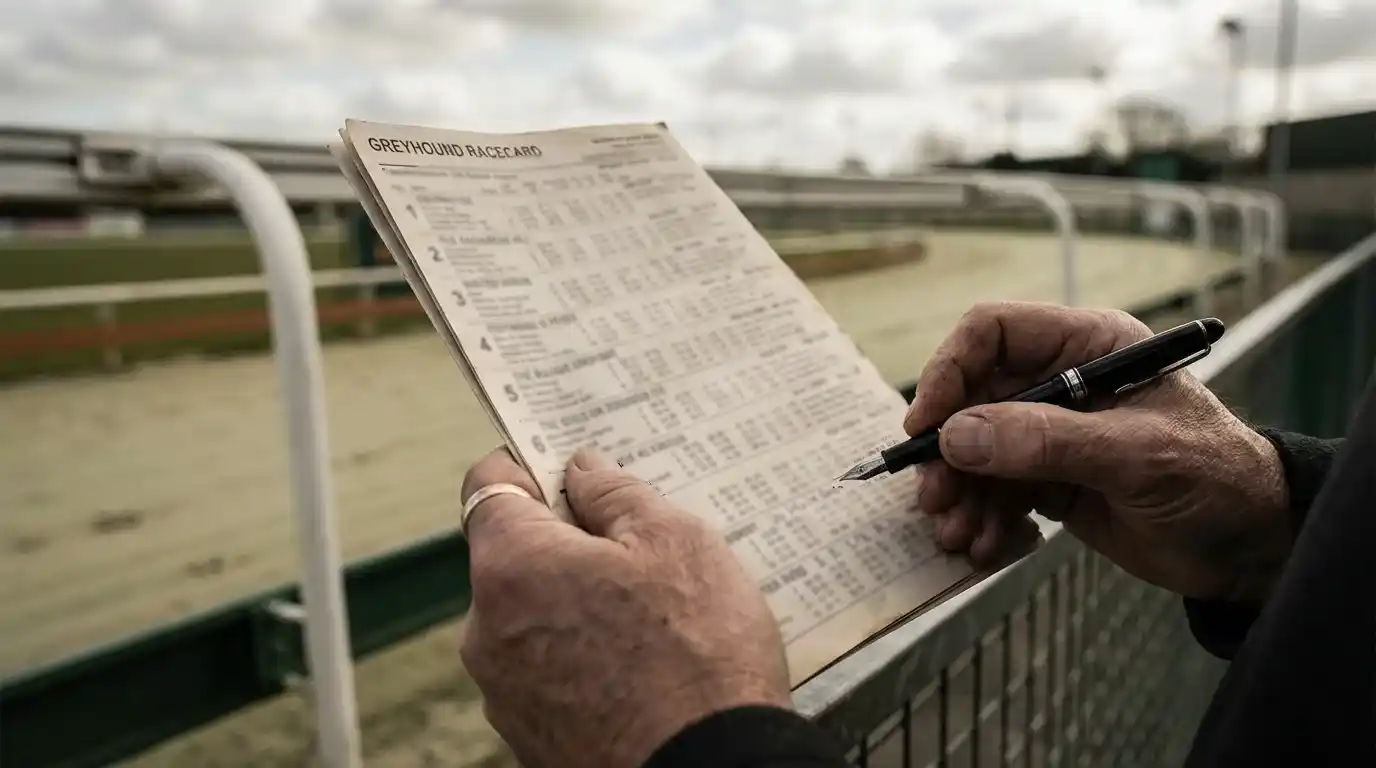
How to Read UK Greyhound Race Cards and Form Data
Every column on the racecard tells a story — but only if you know how to read it. Form is the accumulated record of a greyhound’s racing history: where it has run, how fast, from which trap, against what calibre of opposition, and whether it led, tracked, or came from behind. It is, in every meaningful sense, the language greyhound racing uses to describe itself. Punters who learn to read it gain access to information that the casual bettor — the one picking dogs by name or trap colour — will never see.
The concept of form is not unique to greyhound racing. Horse racing punters study it obsessively, and for good reason. But greyhound form has specific characteristics that make it both more accessible and more revealing than its equine equivalent. The fields are smaller: six dogs instead of twelve or more. The variables are fewer: no jockey changes, no weight allowances, no draw that changes with the going. A greyhound’s form is a purer expression of the animal’s current ability and racing pattern, unfiltered by many of the human factors that complicate horse racing analysis.
That purity is what makes form reading the non-negotiable skill in greyhound betting. You can have strong views on trap draw, a good feel for pace dynamics, and a decent understanding of the grading system — and all of that is useful — but none of it replaces the ability to look at a race card and extract meaningful information from the data in front of you. Form is the foundation. Everything else is built on top of it.
This guide walks through the entire form-reading process, from understanding the anatomy of a race card through to interpreting sectional times, weight changes, and trainer records. The aim is to give you a systematic method for turning raw data into actionable insight, one column at a time.
While analyzing the dog’s past performances is crucial, evaluating trainer form in greyhound racing can give you the ultimate edge when choosing between two evenly matched runners.
Anatomy of a Greyhound Race Card
The race card is not a prediction — it is an evidence file. Every row represents one runner, and every column provides a specific data point that, taken together, builds a profile of how that dog is likely to perform in this particular race. Learning to read the card fluently is the first step in serious greyhound form analysis, and it is worth doing properly rather than skimming for the bits that seem obvious.
A standard UK greyhound race card contains the following for each runner: trap number, dog name, trainer, form figures, best recent time, weight, grade, age, sex, sire and dam, number of runs, and a comment from the race card compiler. Some cards include additional data like sectional splits, calculated time, and days since last run. The depth of information varies between racing services, but the core elements are consistent.
The trap number tells you which box the dog starts from, numbered one (inside rail) through six (outside). The significance of trap draw depends on the track configuration and the dog’s running style, but it is always the first thing to register because it shapes the opening phase of the race. The dog’s name comes next, followed by the trainer — and the trainer column is more important than many punters realise, though we will cover that in its own section later.
The best recent time is the dog’s fastest finishing time over the race distance at this track. It is useful as a baseline, but it requires context. A dog that ran 29.40 on a fast night with a tailwind and a clean run is not necessarily faster than a dog that recorded 29.60 while being bumped at the first bend and losing two lengths. The raw number invites comparison, but the comment and form figures provide the context needed to interpret it.
Weight is recorded in kilograms and typically varies by only half a kilo or so between runs for a healthy greyhound. The number itself is less important than the change over time, and we will dig into what weight fluctuations signal later in this guide.
Decoding Form Figures
The form figures are the compressed narrative of a dog’s recent racing career. They read as a sequence of digits, each representing the finishing position in a recent race, with the most recent run on the right. A form line of 3211 tells you the dog finished third, then second, then first twice in succession. That is a dog in improving form — results getting better with each outing.
Certain characters carry specific meanings beyond simple finishing positions. A zero indicates the dog finished outside the first six (or was pulled up, disqualified, or failed to complete the race). The letter F typically signals a fall. A dash or hyphen usually indicates a break in racing, whether through injury, a spell at the kennels, or a change of trainer. Reading these correctly is important because a string of recent wins followed by a long gap might mean the dog is returning from injury and may not reproduce its previous form immediately.
The trend matters more than any single digit. A form line that reads 5432 shows consistent improvement — the dog is finding its level and climbing toward competitiveness. A line of 1126 tells a different story: a dog that was winning comfortably but has recently lost form, with that sixth-place finish on the most recent outing being the most relevant piece of information. Recency is everything in greyhound form. A dog that won three months ago and has finished fifth in its last four runs is not an improving dog, regardless of what the earlier part of the form line suggests.
One subtlety that separates experienced form readers from beginners is the ability to look beyond the raw positions and consider context. A dog that finished fourth in an A1 open race has arguably performed better than a dog that won a D4 graded contest. The form figures do not capture that distinction on their own — the grade column does. Cross-referencing the two is where genuine insight starts.
Understanding Racecard Comments
The comment line is the race card compiler’s shorthand summary of each dog’s most recent run, and it contains a density of useful information once you learn the abbreviations. Different racing services use slightly varying codes, but the core vocabulary is standardised across UK greyhound racing.
Positional comments describe where the dog was at key points in the race. “Led” or “Ld” means the dog was in front — usually from the first bend. “EvCh” (every chance) means the dog was competitive throughout and had the opportunity to win but did not convert. “Crd” (crowded) or “BMP” (bumped) at a specified bend tells you the dog encountered interference, which may have cost it positions and makes the finishing position unreliable as a measure of true ability.
Running comments describe how the dog raced. “SAw” (slow away) means a poor start from the traps, immediately giving ground to the rest of the field. “Rls” (rails) indicates the dog ran close to the inside rail. “W” (wide) means it raced on the outside. “MsdBrk” (missed break) is a more emphatic version of slow away — the dog effectively lost the start entirely. Each of these comments changes how you interpret the finishing position. A dog that finished third after being bumped at the second bend and missing the break has arguably run better than a dog that finished second with a clear run throughout.
“Fin” comments are perhaps the most revealing. “FinWl” (finished well) or “RnOn” (ran on) tells you the dog was gaining ground in the closing stages — a sign of stamina and potential improvement over further distances. “Fdd” (faded) or “Wknd” (weakened) indicates the dog could not sustain its effort. A dog that leads into the final bend and then fades may lack the stamina for this distance, or it may have gone too hard too early.
Building fluency with these abbreviations takes time, but it transforms the race card from a wall of numbers into a readable narrative. Every comment tells you something about the trip the dog had, and the trip is often more important than the result.
Using Times and Sectional Data
Two dogs might both run 29.50 — but one did it coasting and the other did it under pressure. Overall finishing times are the most commonly quoted performance metric in greyhound racing, and they are also among the most commonly misunderstood. A time means nothing without context, and the context comes from sectional data, going conditions, and the nature of the run itself.
The overall time records how long the dog took from traps to finishing line. In a standard 480-metre race, competitive times at most UK tracks fall between 28.50 and 30.50 seconds, depending on the track, the grade, and the conditions. Faster is generally better, but the margin between a fast track on a dry night and a slow track after rain can be a full second or more. Comparing times across different tracks, or even across different meetings at the same track, requires adjustment for conditions — and many punters fail to make that adjustment.
Calculated time is a more reliable measure. This takes the actual finishing time and adjusts for factors like the distance the dog was behind the leader, producing a figure that better reflects the dog’s true speed rather than its finishing position. A dog that finished three lengths behind the winner might have a calculated time that is faster than a dog that won by a comfortable margin against weaker opposition. Racing Post and Timeform both publish calculated times, and they are worth checking before you rely on raw figures.
Sectional times break the race into phases — typically the time to the first bend, the time between bends, and the time on the run-in. These splits reveal the shape of the dog’s performance. A dog that posts a fast sectional to the first bend but a slow closing split is an early-pace runner that fades. A dog with a moderate first split but a fast closing section is a closer that finishes strongly. Both might record the same overall time, but they are fundamentally different types of runner, and the distinction matters for how you assess them in their next race.
Run-up distance is another factor. At UK tracks, the distance from the traps to the start of the official timing is not included in the race time. This run-up varies between tracks. A dog that is slow out of the traps loses ground during the run-up that does not show in the time but does affect its position at the first bend. Sectional data captures this nuance where overall times cannot.
The practical discipline is comparison. Compare dogs over the same distance, at the same track, in similar conditions. Adjust for the going. Look at the sectionals to understand how the time was produced, not just what it was. A time is a conclusion. The sectionals are the working that got you there.
Weight Changes and What They Signal
Weight is noise — until it isn’t. Most greyhound weight fluctuations between races amount to a few hundred grams and reflect nothing more than normal variation in feeding, hydration, and exercise. A dog that weighed 32.1kg last Tuesday and weighs 32.3kg today has not undergone any meaningful physical change. The punter who adjusts their selection based on two hundred grams is chasing ghosts.
The signal emerges when the changes are larger or sustained over multiple runs. A consistent weight gain across three or four races — say, from 31.5kg to 32.5kg — can indicate that the dog is losing race fitness, carrying too much condition, or not being trained as intensively. Conversely, a gradual weight loss over the same period might suggest the dog is being brought to peak fitness, though it could also indicate illness or stress. Context is everything, and the trainer’s broader pattern often provides the answer.
Sudden weight changes of a kilogram or more between consecutive runs warrant attention. A dog that drops from 33kg to 31.8kg in a week may have been ill or may have been deliberately trained down for a specific race. Either way, the change is large enough to affect performance and should be factored into your assessment. Similarly, a sharp gain might mean the dog has been off the gallops and is racing without full fitness.
Seasonal patterns are also worth noting. Greyhounds tend to carry slightly more weight in winter and slightly less in summer, following natural metabolic rhythms. A modest gain in December is less alarming than the same gain in July. The experienced form reader develops a sense of what constitutes normal variation for a particular dog and flags only the departures from that baseline. For most races, weight is a secondary factor that confirms or raises questions about what the form figures and times are already telling you. It is rarely the primary reason to back or oppose a dog, but it can be the piece that tips the balance when other factors are closely matched.
Trainer Form and Kennel Patterns
The trainer column is the most ignored edge on the race card. Most casual punters skip straight past it, focusing on the dog’s own form and times. But the trainer is responsible for the dog’s preparation, fitness, and racing programme — and trainers, like dogs, go through patches of form that can be tracked and exploited.
A trainer running hot — with a strike rate well above their seasonal average — is doing something right, whether it is peaking dogs at the right time, making shrewd entries, or simply having a kennel in particularly good health. Tracking trainer strike rates over the last fourteen or twenty-eight days gives you a rolling picture of which kennels are producing winners and which are struggling. This data is available through services like Timeform and Racing Post, and it takes only a few minutes to check before a race meeting.
Track-specific trainer records are even more useful. Some trainers perform disproportionately well at certain venues, often because they know the track intimately, time their dogs specifically for its distances, and understand its particular pace biases. A trainer with a 25% strike rate at Romford but a 12% strike rate everywhere else is giving you a clear steer: when their dogs run at Romford, pay attention.
First-run signals are another pattern worth tracking. When a dog appears at a new track for the first time — or returns after a break with a change of trainer — the performance can be unpredictable. Some trainers are known for having their dogs ready first time up. Others use the first run as a fitness sharpener, with the real target being the second or third outing. Learning which trainers fall into which category takes time and observation, but it is the kind of knowledge that gives a quiet, consistent edge over punters who treat every first-run dog the same way.
Trial results, where available, add another layer. When a dog has trialled at a track before its first official race there, the trial time gives you a baseline to work from. Trainers who frequently trial their dogs before racing them are typically methodical operators, and their runners tend to perform closer to expectations than dogs thrown in cold. It is a small detail, but greyhound betting is a sport of small details, and the punters who accumulate them hold the advantage.
Reading Grade Changes
A dog dropping from B3 to C1 is not getting worse — it is finding its level. Grade changes are among the most important signals on the race card, and they are the most frequently misread by punters who do not understand what the grading system is telling them.
In UK greyhound racing, dogs are graded according to their recent performance. Win a race and you may be promoted to a higher grade, where the competition is tougher. Lose consistently and you may be dropped to a lower grade, where the competition is weaker. The system exists to keep races competitive, but from a bettor’s perspective, it creates a cycle of opportunity.
A dog dropping in grade is the classic value scenario. It has been competing against dogs of higher ability, losing, and being reassessed. The losses may have dented its form figures — the string of fourths and fifths looks unimpressive at first glance — but the grade column tells you that those finishes came against better opposition. When the same dog lines up in a lower grade, it may be the classiest runner in the field despite its apparently poor recent form. This is where the casual punter sees a loser and the form reader sees an opportunity.
Grade promotions require the opposite caution. A dog that has won two or three races in a row and gets bumped up a grade is facing tougher opponents for the first time. The winning streak may end abruptly — not because the dog has lost ability, but because it has been placed against animals that are genuinely quicker. Backing a dog off the back of a winning run without checking the new grade is a common and expensive mistake.
Open races sit outside the grading structure entirely and attract the best dogs. Form from open races should be assessed separately, because the standard of competition is higher than any graded race. A dog that finished third in an open race may well be better than a dog that won a B2 the same week. The grade column is the context that makes the form figures meaningful, and reading form without reference to grade is like reading a football score without knowing which league the teams play in.
Putting It All Together: A Form-Reading Walkthrough
Let’s take a race card and walk through it, dog by dog. This is a hypothetical A4 graded race over 480 metres at a standard four-bend track, six runners. The point is not to predict a specific outcome but to demonstrate the process of extracting information and building a view.
Trap 1 shows a dog with recent form of 3214. The last two runs are strong — a first and a fourth — but that fourth was in an A2 race (noted in the grade column), meaning the dog was competing two grades above today’s level and still finished mid-pack. The comment from the last run reads “CrdBnd2, RnOn” — crowded at the second bend, ran on. This dog had interference and still finished respectably in a higher grade. It now drops back to A4 with a rail draw. That is a strong combination of class advantage and favourable draw.
Trap 2 has form figures of 6553, all at A4 with no class relief coming and moderate times. The comments show “Mid” across multiple runs — a neutral running style that does not benefit from any particular trap. A watching brief at best. Trap 5 is similar: form of 4445, slow times at A4 throughout, nothing in the comments to suggest unluck or improvement. Pass on both.
Trap 3 shows 1111 — four consecutive wins. Impressive, but a closer look at the grade column reveals those wins came at A6 and A5. The dog has been promoted to A4 for the first time. The wins are genuine, but the step up in class is significant. The best time is fast for A5 but only average for A4. This is a dog that has earned its shot at a higher grade but is untested at this level. The market will likely make it favourite based on the winning streak, which may offer a value angle in opposing it.
Trap 4 carries form of 2231 with all runs at A4. The recent win was by two lengths, and the comment reads “Ld2, DrwCl” — led from the second bend and drew clear. The dog is racing in the correct grade and winning from the front. The weight is unchanged from the last three runs. This is a straightforward contender with current form at the right level.
Trap 6 has form of 2122 with a mix of A3 and A4 races. The dog has been competitive at a higher grade and now runs at A4 from an outside draw. The comment from the last run notes “SAw, FinWl” — slow away, finished well. A dog that is starting slowly but finishing strongly from the outside trap. If it gets a clean run, the closing speed could be decisive. If it misses the break again, it will be chasing the race from the back in a packed field.
The shortlist from this analysis is Trap 1 (class drop, rail draw, ran on when crowded last time) and Trap 4 (current grade, recent winner, led and drew clear). Trap 6 is the each way angle if you like closers at a price. Trap 3, despite the four-timer, is the potential false favourite. That is form reading in practice: not a formula, but a structured examination of the evidence.
Common Form-Reading Mistakes
The most common mistake is not misreading form — it is ignoring what you have read. Punters who invest the time to study the race card and then override their own analysis based on a gut feeling, a tip from a friend, or a dog’s name that sounds lucky are undermining the entire exercise. If the form tells you something, have the conviction to act on it or the discipline to pass.
Over-reliance on the last result is the next most prevalent error. A dog that won its last race is not automatically the best bet in today’s field. That win may have come against weak opposition, at a different distance, from a more favourable trap, or on a faster track surface. The last result is one data point in a series. Treating it as the only one is recency bias in its purest form, and it leads to backing false favourites who won once and are now being asked to do it again under different conditions.
Ignoring grade context distorts everything. A form line of 5543 looks poor in isolation. But if those finishes were in A1 and A2 races, and the dog is now running in A4, the picture changes completely. Conversely, a form line of 1121 at D3 level means very little when the dog steps up to B4. Every form figure is relative to the grade it was recorded in, and reading them without that reference is like judging a sprinter’s time without knowing whether it was recorded at sea level or altitude.
Failing to adjust for going conditions is another trap. A dog that recorded a fast time on a dry surface may not reproduce it on a wet, heavy track. And a dog that appeared slow last time out may have been battling conditions rather than lacking ability. Track condition is a variable that changes between meetings and sometimes between races on the same card. The form reader who does not check and adjust for it is comparing data sets that are not equivalent.
Finally, there is the mistake of reading form in a vacuum. Every dog in the race has form, and form is relative. The question is not whether Dog A has good form. The question is whether Dog A has better form than Dogs B through F in this specific race, at this distance, from these traps, in today’s conditions. Comparative analysis is harder than absolute analysis, but it is the only kind that produces informed betting decisions.
The Dog Behind the Numbers
Form analysis is a discipline — and like all disciplines, it gets sharper the more you do it. The first time you sit down with a greyhound race card, the columns blur together and the abbreviations feel like a foreign language. By the twentieth time, you start reading them instinctively. By the hundredth, you are spotting patterns before you consciously register them. That progression is not talent. It is repetition applied with attention.
What makes greyhound form reading rewarding is the directness of the feedback loop. You read the form, you make your assessment, the race is run within minutes, and you know immediately whether your reading was accurate. There is no waiting weeks for results, no ambiguity about the outcome. The dog either performed as the form suggested or it did not, and when it did not, the result itself becomes the next piece of form data for you to interpret. The cycle is tight, fast, and educational if you approach it with the right mindset.
The punters who get the most from form reading are the ones who treat it as a practice rather than a formula. A formula implies a fixed set of inputs producing a guaranteed output. Form reading is not that. It is an evolving assessment of probability, shaped by data but ultimately requiring judgment. Two experienced form readers can look at the same card and reach different conclusions, not because one of them is wrong but because they are weighting the available evidence differently. The important thing is that both are working from the evidence rather than ignoring it.
Behind every form line is a greyhound that raced, and behind every race is a set of circumstances that made the result what it was. Your job as a form reader is to reconstruct those circumstances from the data on the card, and to use that reconstruction to make a judgment about what happens next. It is not infallible. No analysis in a sport involving live animals can be. But it is consistent, it is repeatable, and over time, it is the single most reliable edge available to the greyhound punter.
Start with one track. Learn the trainers, learn the traps, learn the typical times. Build your own form book alongside the official one. Note the dogs that impressed you, the runs that deserved better results, the trainers whose dogs seem to arrive ready. Within a few weeks, you will be reading race cards not as a wall of numbers but as a collection of stories — each one telling you something about what might happen next. That is when form reading stops being a task and starts being an advantage.
Master your handicapping skills by exploring the strategies shared on our premier greyhound betting portal.
