
Weather Impact and Greyhound Track Conditions
Best Greyhound Betting Sites – Bet on Greyhounds in 2026
 Available in US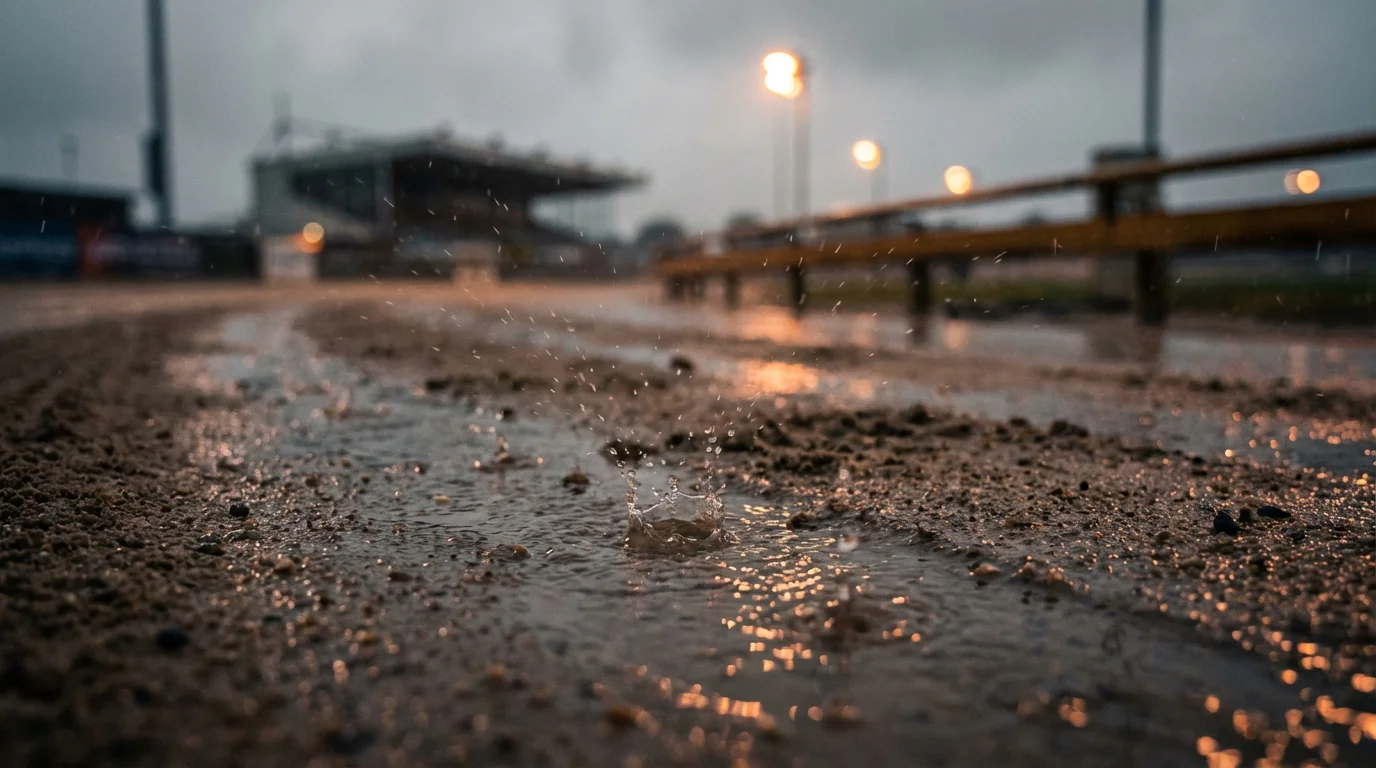
How Track Conditions and the Going Affect Greyhound Races
Sand depth, moisture, temperature — the track is never the same twice. Greyhound punters who treat the racing surface as a constant are ignoring a variable that can add or subtract lengths from a dog’s expected performance. Unlike horse racing, where the going is formally assessed and published before every meeting, greyhound track conditions receive little official commentary. The information is there if you know where to look, but you have to do the work yourself.
Every UK greyhound track is an outdoor sand surface exposed to the elements. Rain, wind, frost, and heat all alter the characteristics of that surface, and those alterations affect how fast dogs can run, how much energy they expend, and which running styles are advantaged or disadvantaged. A dog that posted 29.40 on a fast, dry surface last Tuesday may run 29.80 on a rain-soaked surface this Saturday — not because it is in worse form, but because the track is slower. If you are comparing those two times without adjusting for conditions, your analysis is fundamentally flawed.
Track conditions also vary within a single meeting. The first race of the evening is run on a surface that has been freshly prepared. By the eighth or ninth race, the sand has been churned by dozens of dogs, the inside running line has been compacted differently from the outside, and the characteristics of the track have subtly shifted. Dogs running in the final races of a meeting are not running on the same surface as dogs in the first race, and their times should not be compared directly.
Surface Types and Their Effects
Most UK tracks use sand — but sand quality and depth vary significantly between venues, and those variations produce measurably different racing characteristics.
The standard racing surface at GBGB-licensed tracks is a sand-based compound, typically a mix of fine sand with binding agents that help maintain the surface structure under racing conditions. The depth of the sand layer, the grain size, and the specific composition all differ between tracks, which is one reason why times at one venue are not directly comparable with times at another.
Surface depth is the most important variable. A deeper sand surface is slower because it absorbs more energy from each stride. Dogs sink fractionally further into deeper sand, requiring more muscular effort to maintain speed. Conversely, a shallower, firmer surface allows dogs to run faster because less energy is lost to ground absorption. Tracks maintain their surfaces within a target depth range, but natural variation and wear mean the depth is never perfectly uniform across the entire circuit.
The inside running line tends to be more compacted than the outside because more dogs race near the rail, and the repeated footfall presses the sand down. This compaction makes the inside line slightly faster, which contributes to the statistical advantage of inside trap draws. Over the course of a meeting, this compaction increases, which means the rail advantage may be slightly more pronounced in later races than in the opening events.
Surface maintenance between races involves harrowing — dragging equipment across the track to redistribute the sand and restore a uniform depth. The quality and thoroughness of this maintenance affects racing conditions. A well-harrowed track between races provides a more consistent surface; a hastily maintained one may leave rutted or uneven patches, particularly on the bends where dogs exert the most lateral force. As a punter, you will not always know the state of the maintenance, but observing whether times across a meeting are consistent or increasingly slow can give you indirect evidence.
Some tracks have undergone surface renovations in recent years, replacing older sand compounds with newer materials designed to improve drainage, consistency, and safety. When a track changes its surface, historical times become less reliable for comparison, and dogs may need a run or two to adjust to the new feel underfoot. If you follow a track that has recently resurfaced, treat the first few months of times with extra caution.
Weather Impact on Greyhound Racing
Rain slows the surface. Cold firms it up. Wind affects the outside traps. These three weather effects are the most significant for greyhound racing, and each one can be quantified with a bit of observation.
Rain is the most impactful weather variable. Wet sand is heavier and deeper than dry sand, which slows overall times across the meeting. Heavy rain before or during a meeting can add 0.20 to 0.40 seconds to standard-distance times — a meaningful amount in a sport where margins between dogs are often measured in tenths of a second. Rain also affects grip. Wet sand provides less traction on the bends, which can cause dogs to slide wider than they would on a dry surface. This disadvantages railers who need to hold a tight line and advantages dogs that naturally run wider and handle the reduced grip better.
The effect of rain is not uniform across a meeting. If it rains during the first few races and then stops, the surface gradually dries and quickens as the meeting progresses. If rain arrives mid-meeting, the surface slows progressively. Watching the times from the early races gives you a benchmark for how the conditions are playing, and you can adjust your expectations for later races accordingly.
Cold weather firms the sand surface, particularly after overnight frost. A frozen or near-frozen surface is faster than a wet one and can be faster than a normal dry surface because the compaction increases. However, extreme cold can also affect the dogs themselves — greyhounds are lean animals with little body fat, and they can be less supple in very cold conditions. Meetings in December and January often produce a mix of fast surface times and slightly below-par individual performances as dogs struggle to match their warmer-weather form.
Wind is the subtlest factor but still relevant. A strong headwind on the home straight slows every dog, but the effect is more pronounced for wide runners who face the wind with less shelter from the pack. A crosswind on the bends can push dogs off their line, which has a disproportionate effect on outside traps where there is no rail to run against. Wind is difficult to quantify from home, but if you are at the track or can see the conditions via a live stream, a strong wind should prompt you to adjust expectations — particularly for dogs in the outside traps over longer distances where the wind exposure is sustained.
Adjusting Selections for Track Conditions
When times across a meeting are slow, recalibrate your time expectations — do not assume every dog has suddenly lost form.
The most common mistake punters make with track conditions is interpreting slow times as poor form. If the first three races of an evening all produce finishing times 0.20 to 0.30 seconds slower than normal, the surface is riding slow. Every dog in the later races will be similarly affected. A dog that you expected to run 29.50 based on its recent form may only manage 29.80, but if every other dog in the race is similarly slowed, the competitive picture is unchanged. The dog’s relative ability is the same; only the absolute times are different.
The practical application is to shift your analysis from absolute times to relative performance. Instead of asking “how fast will this dog run?”, ask “how fast will this dog run relative to the others in this race, on this surface, on this evening?” If a dog consistently runs two lengths faster than average in its grade on normal going, it is reasonable to expect it to run two lengths faster than average on slow going as well — the absolute times will be different, but the margins should be similar.
There are exceptions. Some dogs handle adverse conditions better than others. Dogs with a powerful, driving running style may cope with heavy sand better than lighter-framed dogs that rely on quick feet and agility. Dogs with a longer stride may handle a wet, slippery surface better than those with a choppy, short stride. If you can identify these condition preferences from a dog’s historical performance — comparing its results on confirmed slow evenings versus fast evenings — you have an additional edge that most punters do not utilise.
When conditions are extreme — a waterlogged track, a frozen surface, or severe wind — consider whether to bet at all. Extreme conditions amplify randomness. Form analysis is based on normal racing conditions, and the further the actual conditions deviate from normal, the less reliable that analysis becomes. Sometimes the smartest bet is no bet, particularly on evenings where the weather has turned the meeting into a lottery.
Race the Dog, Not the Conditions
Conditions add noise — but the best dogs handle it. That is the principle that should guide your thinking when the weather is foul and the times are slow and the form book seems unreliable.
Over a large sample, the highest-quality dogs perform well in all conditions. They may run slower times on a wet night, but they still beat weaker opposition because their margin of superiority is built on ability, not on a specific surface state. If your selection process identifies dogs with genuine class advantages — better grading, superior running style for the draw, a trainer in form — those advantages persist regardless of whether the sand is fast or slow, wet or dry.
Track conditions are a secondary variable, not a primary one. They deserve attention because they can distort times and create misleading form, and they can occasionally tip a close race in favour of a dog that handles the conditions better. But they should never override your core analysis. A dog that is well drawn, well graded, and in strong form is still a good bet on a slow surface. A poorly drawn dog in poor form does not become attractive just because rain might slow the early-pace dogs and give it a chance to close.
Factor in conditions. Adjust your time expectations. Note which dogs handle adverse going. But build your selections on ability and form first, and let the conditions serve as context rather than the driving force behind your decisions.
